What Moves a Dustless Blasting Quote, Specifically
The wet process changes the job, not just the dust. Here is what a blaster is reading on a dustless quote that a dry job would never raise, and where every one of those factors lands.
The short version
- The general blasting factors apply here too, so this page only covers what the wet process adds or removes.
- Water supply is usually the easy half. What happens to the wet spent media and slurry afterward is the half people forget.
- A rust inhibitor in the water buys a working window on bare steel, and that window shapes how the whole visit gets sequenced.
- Dustless trades lighter drift control for heavier ground cleanup, so containment moves in two directions at once rather than simply going down.
- Sometimes the honest answer is that the job should be dry, and that call gets made at the free on-site look.
The general factors still apply. This page is the wet part.
Every blasting quote is built on the same short list of levers, and those levers do not change because the media is wet. The general factors are covered on the sandblasting cost factors page, and that page is the place to start if you have not read it. Nothing on it gets repeated here.
What this page does is narrower. Dustless blasting, also called wet blasting, injects water into the abrasive stream at the nozzle. The media hits heavier, it stays cooler, and most of what would otherwise hang in the air drops to the ground instead. That one change adds things to the job description that a dry blast never has to account for, and it removes a few others.
So the questions below are the dustless-specific ones: where the water comes from, where the wet spent media ends up, whether an inhibitor step is in the plan, what containment actually looks like when the dust is already down, and whether the job would honestly be better off dry. The wider framework lives on the cost and buying guide, and every factor here ends where the others do: at a free on-site look.
Water on site, and where the slurry goes afterward
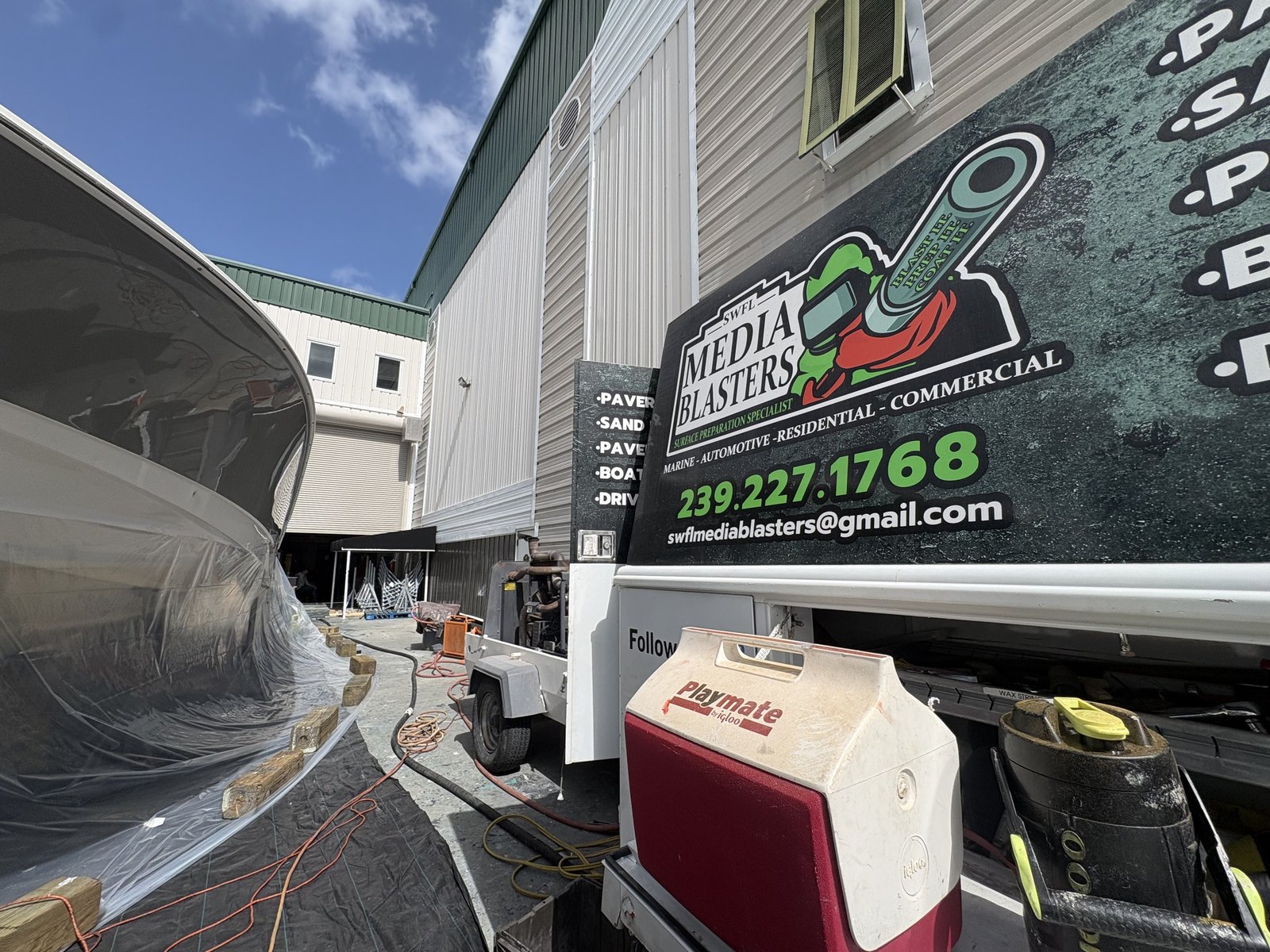
Supply is usually the simple half of this. The rig travels self contained, so a job does not fail because there is no spigot near the work, and a convenient tap you do not mind lending is a small convenience rather than a requirement. What matters more is telling us at the estimate where water is and is not, because a long run from the nearest source is setup time like any other setup time.
The half people do not think about is the other end. Wet blasting produces wet spent media, plus whatever coating just came off the surface, and that mixture does not blow away the way dry dust does. It lands, and it has to be collected. On a driveway or a slab with a clean perimeter that is straightforward. On grass, on shell, on a slope that runs toward a pool cage, a planting bed, a storm drain or a neighbor's lot, the collection plan gets more involved, and that planning is real work in the estimate.
What is being removed matters here too. Antifouling off a hull and older exterior coatings that may carry lead both call for tighter collection than a lightly painted piece of equipment does, and that is true whether the blast is wet or dry. Ask any outfit you are comparing where the spent media ends up. It is one of the fastest ways to tell two quotes apart.
The inhibitor step and the clock on wet bare steel
Bare steel plus water plus humid Southwest Florida air is the textbook recipe for flash rust, and it would be dishonest to pretend the wet process does not raise the question. It does. The answer is a rust inhibitor mixed into the water, and what that buys is a working window on the freshly cleaned metal before light surface oxidation appears.
That window is not decoration, it is a scheduling constraint, and it shows up in the estimate as sequencing rather than as a line of its own. If a coating is following the blast, the two get planned back to back rather than as separate visits with a weekend in between. The forecast matters as well, since the metal's temperature and the humidity on the day decide whether a coating can go on at all. If your own painter or powder coater is taking the piece, say so before the date, so the bare steel is not left waiting on someone else's calendar.
Some coating systems are fine with a tight, uniform flash and some are not, and a few specs want a final pass before the first coat. Which one applies to your job is worth settling before anybody opens a valve. Existing corrosion is a different question with its own answers, covered on rust removal.
Lighter masking, heavier cleanup: the containment trade
People assume dustless simply means less containment, and that is only half right. Drift control does get lighter, because the water weighs the particles down and they fall close to the surface instead of traveling across a yard and settling on cars, screens, air intakes and everything else nobody wanted dusted. That shrinks the exclusion zone, and a smaller exclusion zone is where a wet job gets lighter.
What does not shrink is the ground. Everything that came off the surface is now sitting wet within a short distance of where you were working, and picking that up properly takes time that a dry job spends on tarping and taping instead. So containment does not disappear, it moves. On an open lot with nothing nearby and easy footing, the wet job is clearly the lighter one. In a tight side yard squeezed between a pool cage and a planting bed, the masking comes back and the collection is harder as well.
The honest framing for a quote is that dustless changes the shape of the containment work rather than deleting it. Where it sits on your property is the thing that decides which way that trade lands, which is exactly why the on-site look beats a phone description. See how the same trade reads on a town page such as dustless blasting in Naples.
Occupied homes, open businesses and working hours
The most familiar reason a job goes wet is that the property cannot stop. A house that is lived in, a storefront that is open, a shop with a line running, a yard where other crews are working: all of those are places an open dry cloud is a problem, and all of them shape the estimate before anyone talks about the surface.
Scheduling is part of the number. Work that has to fit around business hours, quiet hours, gate access windows, a marina or boatyard's own rules, or a stretch when the pool deck has to be usable is work with a shape imposed on it from outside, and that shape can mean shorter sessions, more setups and more breakdowns than one long uninterrupted pass would need. None of that is a penalty. It is simply more visits' worth of setup for the same surface.
The case for keeping an operation running while the blasting happens is made in full on dustless blasting for business, so it is not re-argued here. What belongs in this page is the estimating consequence: tell the blaster about the constraints at the estimate, not after the date is booked. The Fort Myers dustless page shows what that looks like in a commercial setting.
Thin panels, heat, and why dustless gets chosen at all
The other big reason to run wet has nothing to do with dust. A dry stream generates heat through friction, and thin material is what that heat warps: body panels, hatches, fenders, light-gauge sheet steel, aluminum. Water in the stream pulls that heat out of the metal as the pass moves, so the panel keeps its shape while the coating still lets go.
On the estimate that reads as an enabling factor rather than a cost driver. It is what makes a thin-panel job possible without the risk of handing you back something warped, and warped is not a repair anybody wants to price. The same property is why the wet stream suits gelcoat and hull work, where the goal is taking coating off without touching the laminate underneath.
What still applies is the trade's first rule: the substrate sets the ceiling. A delicate material limits the media and the pressure no matter how stubborn the coating is, and a stubborn coating on a delicate substrate is a slow job in any method. Running wet does not make a soft surface tough. It removes the heat variable and the drift variable, and leaves the rest of the factors exactly where they were.
When dry is the better call, and what switching does to the plan
Sometimes the right answer is that your job should not be wet at all. If the surface has to be bone dry for a coating going on immediately, water is working against you. If the job is heavy structural steel in the open where nothing nearby cares about dust and raw cutting speed is the whole point, dry is faster. If the footing or the drainage makes wet collection genuinely awkward, that is a reason too. Straight dry work is covered on the sandblasting page.
A job can also change media partway through, and that is normal rather than a red flag. A trailer combines steel rails, aluminum fenders and a wooden plank deck, three materials sharing one frame, and a single setting run end to end would be wrong for at least one of them. Crushed recycled glass and garnet handle paint and rust on steel, baking soda takes the delicate and finished material, and the wet stream goes wherever drift and heat are the problem. More than one of those on a single job means more than one setup, and setups are time.
All of which lands in the same place. SWFL Media Blasters is based in Naples, has been blasting since 2015, and rolls the rig to wherever the piece already sits; the on-site estimate is free. Call or text (239) 227-1768, or reach us through the contact page.