What Drives the Cost to Strip and Reseal Pavers Here?
The real factors behind pricing a paver-sealer strip-and-reseal in Naples, Cape Coral and across SW Florida, with honest ranges and a free look on site.
The short version
- Square footage, sealer type, and how many old layers are stacked on are the three biggest cost drivers on any paver job.
- A driveway with one thin coat of acrylic strips faster, and cheaper, than a lanai buried under years of glossy resealing.
- Cloudy, peeling, or flaking sealer usually has to come off completely before a fresh coat will bond, which adds labor.
- Media blasting strips sealer evenly without flooding joints or blowing out paver edges the way aggressive pressure washing can.
- Nobody can quote pavers blind. A quick on-site look at your sealer and condition is the only way to price it right.
Why can't anyone quote pavers over the phone?
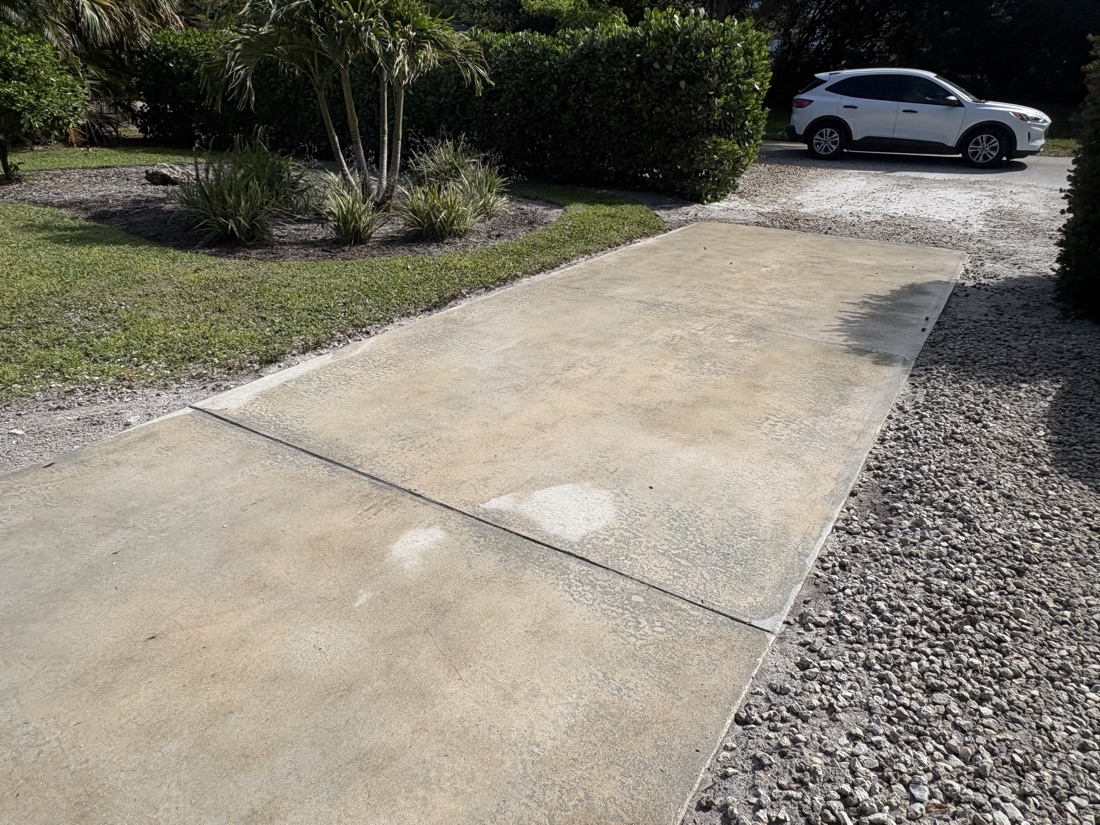
Paver work is one of those jobs where two driveways that look the same from the street can price out very differently. The number that lands on your estimate depends on what's actually sitting on top of the pavers and underneath that glossy haze, and you can't see all of it in a photo.
One driveway might have a single thin coat of acrylic sealer that's barely there. The one next door might have five years of resealing stacked on top of itself, going cloudy and peeling at the edges. Same square footage, very different amount of material to remove. The condition of the pavers underneath matters too, since cracked, sunken, or efflorescence-stained brick changes the prep before anything gets recoated.
That's why a free on-site look beats a guess every time. We'd rather walk the surface, see how the old sealer is failing, and give you a real number than throw out a phone quote that falls apart once we're standing on the driveway. You can set up an estimate any time.
How much does square footage really move the price?
Square footage is the most obvious driver, and it works about how you'd expect: a two-car driveway costs less than a long circular drive, and a pool-deck lanai with a wraparound paver patio is bigger than both. More surface means more blasting time, more media, and more cleanup.
But raw size isn't the whole story. Layout matters. A wide-open rectangular driveway moves fast. A space chopped up with planter beds, a screened lanai cage, a pool coping edge, steps, and tight corners slows the work down because every transition has to be handled by hand. Detail work around a pool deck or a residential paver area takes longer per square foot than open ground.
So when you compare estimates, look past the total. A bigger surface that's all one clean field can sometimes price out friendlier per square foot than a smaller, fussy lanai full of obstacles. We measure the real working area, not just the footprint on a tax record.
Does the type of sealer change the job?
It changes it a lot. Not all paver sealer comes off the same way, and the product that's already on your pavers sets the pace for the whole job.
- Water-based acrylics are common in Southwest Florida and tend to release with less effort, especially a single thin coat.
- Solvent-based acrylics bite harder and often need more passes, particularly the glossy "wet-look" finishes people love on lanais.
- Film-forming sealers that have failed (cloudy, peeling, or trapping moisture) are their own challenge, because the goal is to lift every bit of the failed film so a new coat can breathe and bond.
This is where blasting earns its keep. Dialed-in media removal strips sealer evenly across the surface instead of chasing it stripe by stripe, and it can do it without the harsh chemical strippers a lot of homeowners want to avoid near a pool, a lawn, or the lanai screen. If you want the technical walkthrough, see how to remove old paver sealer.
How does layer buildup drive labor up?
Here's the factor most people underestimate. Sealer is supposed to be refreshed every couple of years, and the common mistake is recoating without removing the old layer first. Do that a few times and you end up with a thick, brittle stack of sealer films layered on top of each other.
Each of those layers has to come off. A driveway on its first coat is a quick strip. A lanai that's been resealed four or five times, with each coat clouding a little more than the last, is a much heavier removal job, and that extra material translates straight into labor time. It's the single biggest reason two similar-size surfaces can land at different prices.
It's also why "just reseal it" rarely fixes a hazy, peeling finish. You're sealing over the problem. Stripping back to clean, bare paver and starting fresh costs more up front but actually solves it. For the bigger picture on bringing a lanai back, read about restoring a pool deck and lanai with blasting.
Why not just pressure wash it yourself?
A pressure washer will knock down dirt and some loose sealer, and for routine cleaning it's a fine tool. The trouble starts when people crank up a turbo nozzle to fight cured or layered sealer.
High-pressure water on pavers tends to do three things you don't want: it floods the polymeric sand out of the joints, it etches and scars the surface of softer pavers, and it can chew the edges and chamfers, leaving a fuzzy, pitted look. You also rarely get an even result, since the sealer comes off in patches and streaks. Then you're stuck re-sanding joints and living with an uneven surface before you can even think about resealing.
Controlled media blasting removes sealer uniformly with far less collateral damage to the paver faces and joints, which is exactly why we lean on it for paver sealer removal. We break down the full comparison in pressure washing vs media blasting a driveway.
What about Southwest Florida conditions?
Our climate is hard on sealer, and that shows up in the work. Gulf salt air, brutal summer humidity, daily afternoon storms, and relentless UV all push acrylic sealers to cloud, yellow, and peel faster here than they would up north. Add the moisture that wicks up through pavers laid over our sandy soil, and a film-forming sealer that can't breathe will haze over and lift.
That's why so many Naples, Marco Island, and Cape Coral driveways and lanais reach the strip-and-reseal stage sooner than homeowners expect. The local move is to time the work for our drier winter and spring stretch, since fresh sealer needs dry pavers and a dry window to cure properly, and that's tough to find in a July downpour.
Because we're mobile across Southwest Florida, we bring the rig to your driveway or lanai and work around the surface and the weather. Blast it, prep it, coat it, done at your place.
How do I get a real number for my driveway?
The honest answer is that the best estimate comes from someone standing on your pavers. We come out, look at the sealer you've got, count the layers, check the condition of the brick and joints, measure the real working area, and talk through whether you want a fresh sealer or a natural matte finish afterward.
From there you get a straight number with no surprises, and no pressure. Costs vary with everything we've covered on this page, square footage, sealer type, layer buildup, and condition, so a quick visit is genuinely the fastest way to know where you stand.
We'd rather give you an accurate number after five minutes on your driveway than a wrong one over the phone.
Call or text (239) 227-1768, or request your free on-site estimate. We cover Naples, Bonita Springs, Estero, Fort Myers, Cape Coral, and the surrounding area, and the look is always free.