Soda Blasting vs Sandblasting for Fiberglass and Gelcoat Hulls
Why soft, low-pressure media protects gelcoat on fiberglass boats, and the few cases where harder abrasives still make sense.
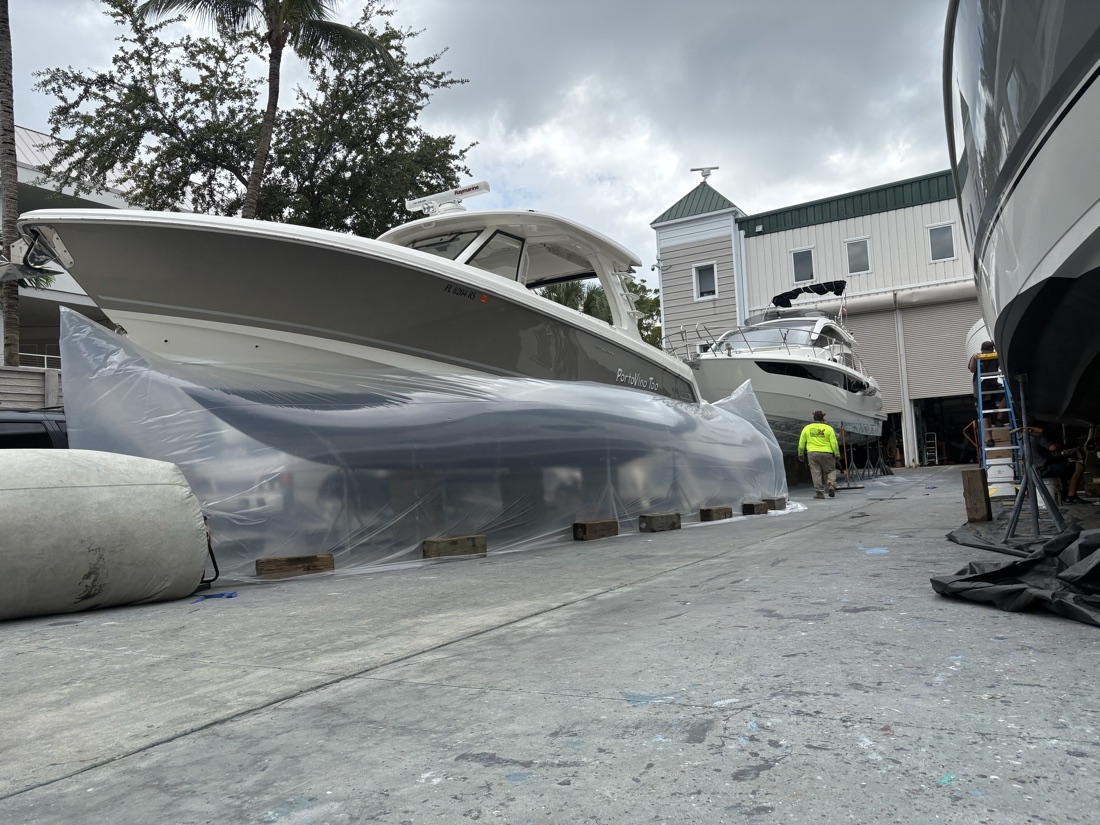
The short version
- Soda blasting uses soft sodium bicarbonate at low pressure, so it lifts paint without cutting into gelcoat or fiberglass.
- Traditional sandblasting throws hard, angular grit that can gouge gelcoat and expose the laminate underneath.
- For boat bottoms and topsides, soda or dustless glass blasting is almost always the right call.
- Hard abrasives still have a place on steel hulls, running gear, and heavy structural rust.
- The wrong media on fiberglass can turn a paint job into a fairing-and-recoat repair, so match the method to the substrate.
What is the real difference between soda and sandblasting?
Both methods fire abrasive media through a nozzle to strip a surface, but the media and the energy behind it are worlds apart. Soda blasting uses sodium bicarbonate, the same family as baking soda, milled into crystals that are soft and friable. They shatter on impact, releasing energy as they break apart rather than driving into the surface. That is what makes soda gentle enough for a fiberglass boat bottom.
Traditional sandblasting throws hard, angular grit, historically silica sand, now more often crushed glass, garnet, or aluminum oxide, at high pressure. Those particles do not break easily, so they cut. On steel that is exactly what you want, a clean, profiled surface ready for coating. On gelcoat it is too aggressive.
The short version: soda removes coatings by lifting them; hard abrasive removes coatings by cutting. When you are working over a thin gelcoat skin, lifting beats cutting every time. Our marine blasting crew chooses the media around your substrate, not the other way around.
Why does soda protect gelcoat and fiberglass?
Gelcoat is a resin-rich outer layer, often only 15 to 25 mils thick, that seals and protects the fiberglass laminate underneath. Once you cut through it, water can wick into the glass, and you are no longer doing a paint job, you are doing a repair. Protecting that layer is the whole game on a fiberglass hull.
Soda works because the crystals are softer than cured gelcoat. At the low pressures we run, the media strips bottom paint, oxidation, and old coatings while the gelcoat shrugs it off. The hull comes out clean and intact, with the original surface preserved instead of ground away.
- Soft media: sodium bicarbonate is far softer than the resin it cleans.
- Low pressure: less kinetic energy reaching the surface.
- Friable particles: they break apart on impact rather than digging in.
That combination is why soda is a go-to for boat bottom paint removal on fiberglass, and a smart choice anywhere you need the substrate to survive untouched.
When is sandblasting still the right call?
Soda is not the answer for everything. Its gentleness is a strength on gelcoat and a weakness on heavy rust. Soda will not aggressively profile steel or chew through thick mill scale and corrosion, and that is where harder abrasives earn their keep.
For a steel hull, running gear, trailers, or structural steel, a cutting media like crushed glass or garnet removes rust fast and leaves the anchor profile a coating needs to bite. Aluminum sits in the middle, it is softer than steel and dents easily, so media and pressure have to be dialed back, but it still usually wants something with more cut than soda.
The decision really comes down to the substrate and the goal:
- Fiberglass or gelcoat: soda or dustless glass, keep it gentle.
- Steel and heavy rust: hard abrasive for cut and profile, see rust removal.
- Aluminum: a careful middle ground to avoid denting.
A good blaster reads the job before picking up the nozzle. If you are unsure, that is what a free on-site look is for.
Where does dustless blasting fit in?
Dustless blasting is a third option that often gets lumped in with the others, and in Southwest Florida it is worth understanding. Instead of dry media, it mixes recycled glass abrasive with water. The water adds mass so the media cuts efficiently, but it also traps the dust, knocks down heat, and reduces friction sparking.
For boats, the water film does two useful things. It keeps surface temperature down so you are not stressing the laminate with heat, and it captures spent media and old antifouling instead of letting it drift across a boatyard or marina. That matters when you are working near the water, near other boats, or on a customer's driveway.
Dustless can be tuned soft enough for fiberglass and topsides, or run harder on metal, which makes it flexible across a mixed job. We cover the details on our dustless blasting page, but the headline is simple, you get an effective strip with far less mess and a cooler, gentler process than dry sandblasting.
What happens if you use the wrong media?
Using a hard abrasive on a fiberglass hull is the classic mistake, and it is an expensive one. The grit gouges the gelcoat, leaves a rough, pitted surface, and can blow right through into the laminate in spots. Now the boat needs fairing compound, gelcoat repair, or epoxy barrier work before it can even be primed, time and money that a softer media would have saved.
Run the wrong pressure and you can do similar damage with the right media. Too much pressure with soda is gentler than too much pressure with garnet, but on thin or already-thin gelcoat, aggression still leaves its mark. Salt-air boats around Naples and Marco Island often have weathered, chalky gelcoat to begin with, which leaves even less margin for error.
Matching media and pressure to the substrate is not a detail, it is the entire difference between a clean prep and a repair bill.
That is why we test and adjust on the actual surface before committing. If you have already had a hull stripped too hard, we can also help you prep the hull for new antifouling the right way.
How do you choose the right method for your boat?
Start with the substrate. If it is a fiberglass boat with a gelcoat finish, which covers most recreational hulls in our area, soda or dustless glass blasting is almost always the answer. If it is steel or you are fighting heavy structural rust, a cutting abrasive makes sense. Aluminum needs a careful, dialed-back approach in between.
Then think about the goal. Are you stripping old bottom paint down to clean gelcoat for a fresh antifouling system? Are you removing oxidation before a topside refinish? Are you cleaning metal down to bright steel for a coating? Each goal points toward a media and pressure, and a single boat might call for more than one in different areas.
Because we blast, prep, and coat as one crew, we plan the strip with the coating in mind from the start. Want a straight answer for your specific hull? Reach out or text the shop and we will come look at it on-site, no charge, and tell you honestly which method fits.