What Moves a Soda Blasting Estimate, and Why Gentle Takes Longer
Soda is chosen for what it will not do to the surface underneath. That protection is the whole point, and it is also the thing that shapes the plan from the first pass to the final rinse.
The short version
- Soda fractures on impact instead of cutting, so removal takes more passes and time on the surface is the biggest single factor.
- You choose soda for what survives underneath it, so the substrate drives the plan far more than the coating does.
- Soda is water soluble but not invisible, and the rinse-down and where that water goes are part of the work.
- Soda leaves no anchor profile, so if a coating follows, a second prep step may belong in the same plan.
- On heavy rust or thick industrial coatings soda is the wrong tool, and switching media changes the whole estimate.
Read the general factors first, then add what soda changes
The handful of levers behind any blasting estimate, from the size and shape of the area to whether a coating follows, are laid out plainly in what moves a sandblasting quote. The general factors are covered there rather than repeated here, and they apply to soda work exactly as they apply to everything else.
This page picks up where that one stops. Soda is a genuinely different media from crushed glass, garnet or sand, and it changes the shape of an estimate in ways the general framework does not fully explain. The short version is that soda gets chosen for what it refuses to do to the surface below the coating, and everything else about the plan follows from that decision.
So read the general factors, then read these. Together they tell you which direction your own job pushes before anybody stands in front of it. And as with everything else in the cost and buying guide, this ends where it always ends: with a free on-site look, somebody standing on your actual surface and writing an estimate from what is there.
Soft media, slow cut, and why time on the surface is the main lever
Sodium bicarbonate is friable. The crystals shatter the instant they land and spend their energy breaking the bond between a coating and the material rather than cutting into anything. That single property is the reason soda blasting exists, and it is also the reason the clock behaves differently than it does with a cutting abrasive.
A media that does not cut has to work by repetition. On a thin, already failing coating that is barely an issue, because the bond gives up quickly and the surface clears at a reasonable pace. On a thick, well bonded or multi-layer finish the same softness means more passes over the same square foot, and the operator has to keep working an area until the last of it releases instead of driving straight through it.
So when a blaster looks at a soda job, the question is not only how much area there is. It is how much material is sitting on that area and how tightly it is held. Two surfaces the same size, one carrying a single tired coat and the other carrying years of stacked refreshes, are not the same amount of work even though the media and the setup are identical. That difference is where a soda estimate moves the most.
You are paying for what survives underneath
Soda is almost never chosen because it is the fastest way to remove something. It is chosen because the material underneath cannot take anything harder, and that reframes the whole conversation about what an estimate is buying.
Gelcoat is the classic example. It is thin, it does not grow back, and going through it turns a paint removal job into a fairing and repair job. Aluminum and thin sheet metal are the same argument in a different material: they dent, they warp under heat and they show every mistake permanently. Travertine and soft natural stone can be textured by an aggressive abrasive in a way no cleaner will ever undo. Chrome, glass, plastic, aged wood, older brick and assembled equipment full of gaskets and seals all belong on the same list.
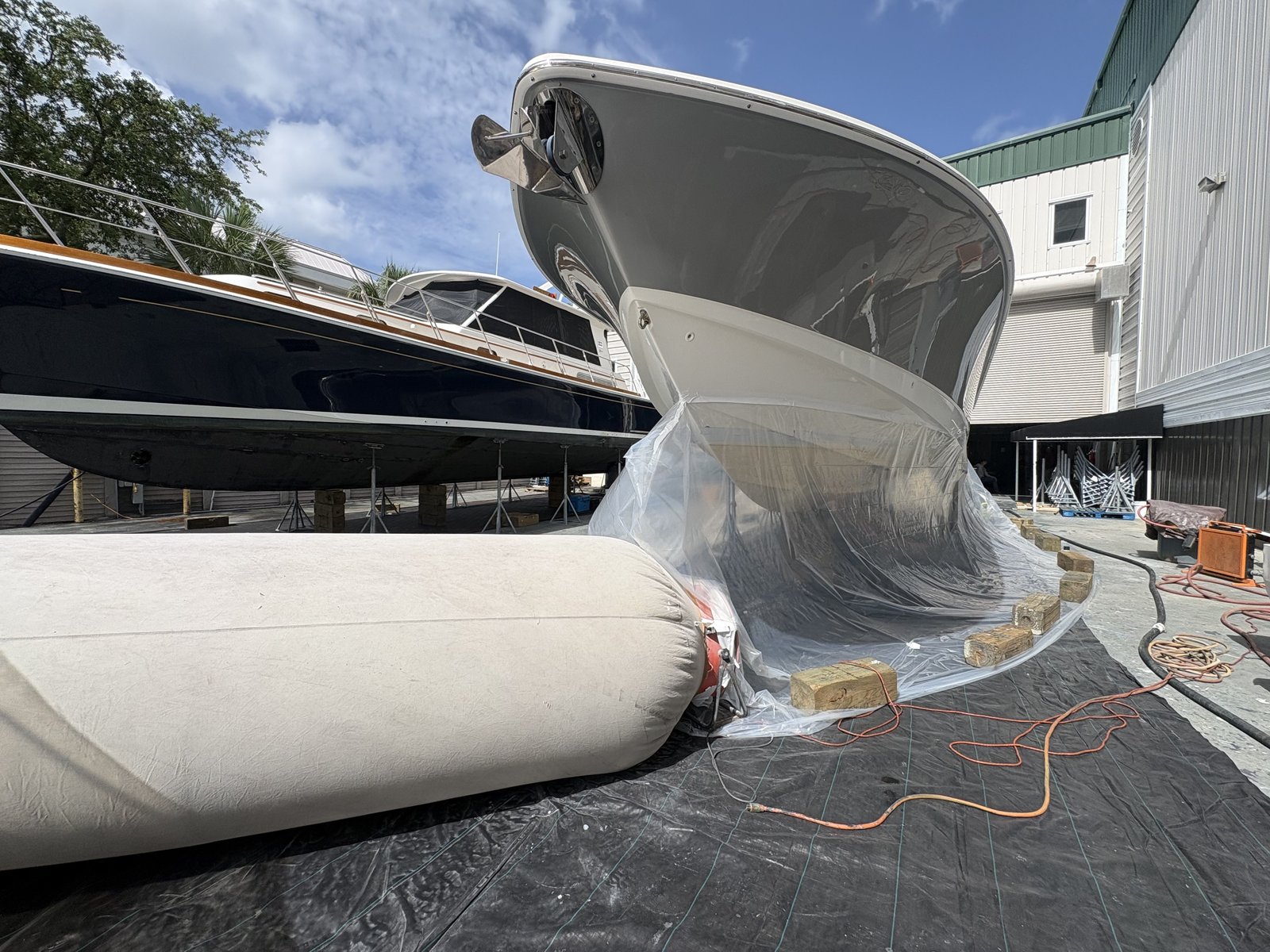
On any of those, the coating does not become easier to remove just because the surface is delicate. The removal simply has to happen within limits the material sets, which means softer media, lower pressure and a slower, more deliberate pass. That is the trade, stated honestly: a longer job in exchange for a surface you still own at the end of it. Where that trade gets made on hulls and hardware is covered on the marine blasting side of the business.
The rinse-down is real work, not an afterthought
Soda being water soluble is one of its genuine advantages, and it gets described often enough that people assume cleanup takes care of itself. It does not. Soluble means the residue can be washed away rather than vacuumed out of every crevice. It still has to be washed away, and where that water goes is part of the plan.
Spent soda leaves a fine residue across the work area and anything near it, and it settles into joints, seams, fasteners, recesses and the ground around the setup. Left in place it interferes with whatever is meant to bond next, so the rinse is not cosmetic, it is prep. On assembled equipment and detailed parts the rinse can run as long as the blast pass, because every pocket has to actually be cleared.
Then there is where the rinse water ends up. Landscaping, pool water, a screened lanai, a neighbor's property, a boatyard surface and the water beside it all shape how the rinse gets handled and contained. The media itself is baking soda, but the rinse carries the removed coating along with it, and a heavy dose of spent soda is not something a planting bed or a pool wants either, so runoff gets directed away from both. A wide open shop floor is straightforward. A pool deck inside a cage, or a hull blocked in a working yard, needs the runoff planned before the first pass rather than chased afterward. That planning is time, and time is what an estimate is made of.
Soda leaves no anchor profile, and that matters if a coating follows
Here is the factor that surprises people most, and it has nothing to do with removal at all. Soda lifts a coating without cutting the surface, which is exactly the point. The consequence is that it also does not leave an anchor profile, meaning the fine texture some coatings need to lock into.
For plenty of work that is irrelevant. If the goal is a clean gelcoat hull, a degreased engine casting, brick or wood you want to leave bare, or a surface where the next product is designed to bond to a smooth substrate, soda hands you exactly what you asked for and nothing more needs doing.
If a coating that wants profile is going on afterward, the plan has to account for it, and that may mean a second prep step with a different media once the soda work is finished. This is not a hidden cost so much as a scope question that belongs in the first conversation. Tell whoever is quoting the job what goes on the surface next, or whether you are handing it to your own painter, powder coater or applicator, because a strip-only job and a strip-then-profile-then-coat job are two different scopes described by the same sentence.
When soda is the wrong media, and what changes when it is
An honest cost page has to include the case where the method you asked about is not the one you need. Soda has a hard ceiling, and running past it wastes everybody's day.
Heavy rust is the clearest example. Scaled, pitted corrosion is a volume of material problem, not a surface film, and a media that fractures on impact will not reach the bottom of every pit at any reasonable pace. Thick industrial and two-part coatings engineered specifically not to release are the same story. Structural steel, trailer frames, heavy equipment and anything that needs a profile for the coating that follows all sit outside soda's useful range.
When that is the situation, the plan switches to crushed recycled glass or garnet, and the estimate changes with it because the pass rate, the containment, the cleanup and the media are all different. Mixed assemblies are the interesting middle: a boat with a gelcoat hull and steel running gear, or a trailer with steel rails and aluminum fenders, may honestly call for more than one media and masking between them. That is a normal plan rather than a complication, and it is far better identified during the walk than halfway through the job. For heavy corrosion specifically, rust removal covers what that work actually involves.
Masking, dust and how to get a real number
Soda is gentle on the substrate and still throws a fine airborne cloud, which is why masking on soda work is often heavier than people expect. Everything staying put gets covered: glass, screens, fasteners, lighting, plantings, vehicles, pool water and the boat or the building next to yours. Interior work and enclosed spaces need the area sealed off before anything starts. When drift is the worry, a wet setup drops the cloud at the surface, and dustless blasting is that version of the work.
How much of that a location needs varies enormously, and it is one of the honest reasons a number cannot come over the phone. Nothing nearby on an open lot means light masking. Inside a pool cage, at a marina slip, in an occupied business or down a tight side yard behind a gate, it is not light at all.
When you compare bids, compare scope rather than totals. Ask which media each outfit would run and the reason, whether the scope stops at the strip or runs through the coating, how the rinse and the spent media get handled, and for proof of the license and the insurance that cover work on your property or your boat. SWFL Media Blasters is Naples based, has been blasting since 2015, is fully mobile, and never charges for the on-site estimate. Call or text (239) 227-1768 today, or start the conversation on the contact page. For how the service reads in one town, see soda blasting in Naples or soda blasting in Bonita Springs.