Wet blasting gets most of the attention, but the hardest Fort Myers surfaces still call for a dry stream: heavy steel, mill scale, thick industrial coatings and bare concrete, where cutting speed and the profile left behind matter more than holding the dust down.
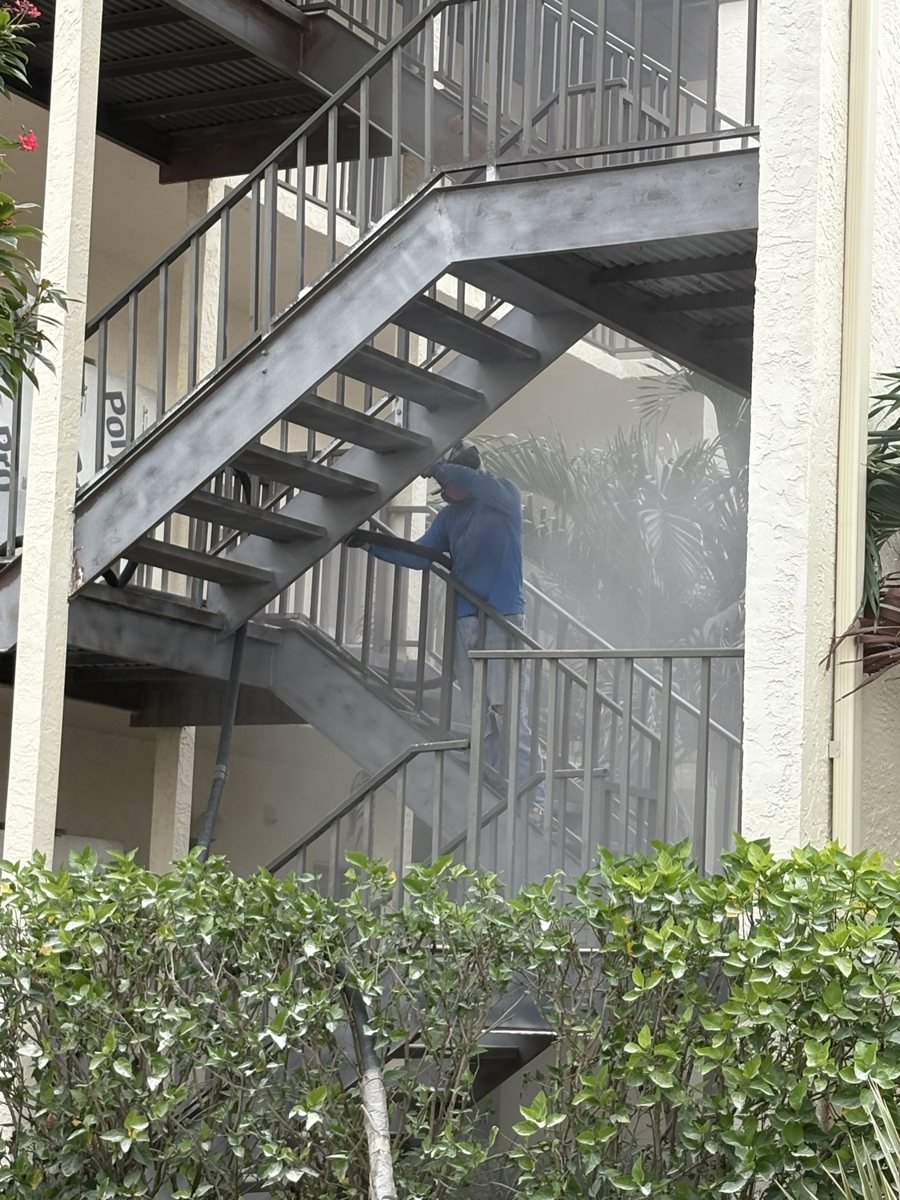
SWFL Media Blasters brings a mobile blast rig to Fort Myers job sites, whether that is a contractor lot off Alico Road, a flex unit where Metro Parkway meets Colonial, an older property on the streets around McGregor Boulevard, or a new build out past Daniels Parkway toward Gateway. Sandblasting is the word people search, and dry abrasive is genuinely part of what leaves the nozzle: crushed recycled glass and garnet, driven hard enough to lift mill scale, thick industrial film and rust that has crept under the paint off steel, and old paint, adhesive and coating off concrete and block. Dry is not the answer to every job in Fort Myers, and this page is about the ones where it is. Call or text (239) 227-1768 for a free on-site estimate.
Dry abrasive and wet dustless are two settings on the same idea, and the site usually picks which one you get. Dry cuts faster through hard, thick coatings. There is no water to source and no slurry to squeegee up afterward, and nothing is left damp on freshly cut steel, so the surface can go straight from bare to primed. On mill scale, industrial coating built up over years, and rust that has traveled underneath the paint, a dry stream of garnet or crushed glass simply takes more off per pass.
Wet takes the other half of the ledger: an occupied yard, a stocked warehouse, a shop where customers park close to the work, a thin panel that would warp under a dry stream. That side of the decision belongs to dustless blasting in Fort Myers, and this page will not re-argue it.
So the question at a Fort Myers estimate is not which setup we prefer. It is how hard the coating is, how much profile the next coating needs, how close the neighbors and the finished surfaces sit, and whether water can be handled where the piece is. An open contractor lot off Alico Road with room to tarp answers that very differently than a multi-tenant unit sharing a loading apron. We look, then we choose. The method itself is laid out on the sandblasting page.
Steel gives you two versions of the same problem. New hot rolled stock carries mill scale, a tight bluish skin left from the mill that paint will bond to for a while and then let go of in sheets when the scale itself releases. Old steel carries the opposite: a coating that failed first at the cut edges, the welds and the fasteners, with scale spreading sideways underneath the paint where nobody notices until it flakes.
In Fort Myers that means the building steel and yard machines covered on commercial blasting in Fort Myers, plus tanks, dump bodies, trailer frames, gates, fencing and any heavy section that lives outside year round. What this page owns is the cut itself. A wire wheel followed by a fresh coat polishes the top of the failure and leaves the rest in place. A dry stream removes scale, rust and film in a single operation and cuts the anchor profile the next coating keys into, which no hand tool produces.
Garnet, being the heavier grain, goes on deep scale and structural sections. Crushed recycled glass handles lighter coatings and general paint and rust. Pressure, nozzle distance and angle all move with the thickness of the section. The coating handoff is its own subject: structural steel prep and surface profile. If rust, not coating, is the real problem, the page for that is rust removal in Fort Myers.

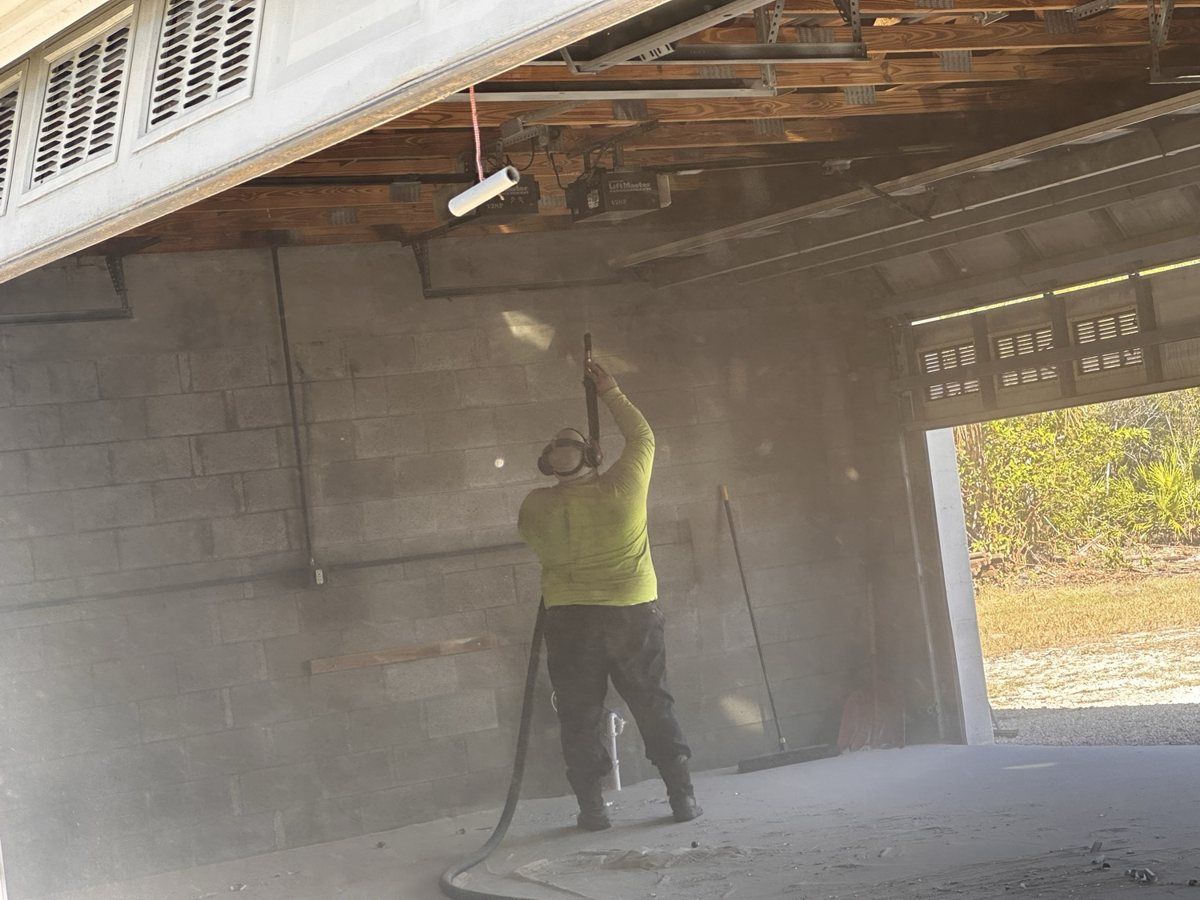
Concrete is the other place dry abrasive earns its keep. Shop and warehouse floors around Fort Myers carry old epoxy, mastic, carpet adhesive and layers of floor paint that a scrubber will never touch. Loading aprons and equipment pads pick up coating, sealer and traffic film. Painted block and stucco walls chalk and peel. Stair treads, curbs and bollard bases end up with three finishes stacked on them.
Concrete does not behave like steel under a nozzle, and that is the skill. Blasting lifts the coating and also removes laitance, the weak dusty layer at the very top of a poured slab that so many failed floor coatings were actually stuck to. Go too aggressive and you start exposing aggregate and leaving a surface rougher than the new product wants. So a test patch happens before the field, and the setup is dialed to the finish going on afterward, not just to what is coming off.
Dry has one practical advantage on masonry that is easy to miss: a porous slab does not end up soaked right before a coating goes down, so there is no waiting on the concrete to give the water back. Paint on block, brick and poured walls is covered in removing paint from concrete, brick and block. Sealed paver drives and travertine are a softer, more delicate job with its own rules, and those belong to paver sealer removal.

Dry means fines and rebound travel, so the plan starts well before the compressor does. Ground cover under the work, tarps and screens on the open sides, plastic on anything staying put, and a hard look at which way the wind is moving that morning. Then the survey nobody thinks about: how far to the parked cars, the pool cage, the AC condensers, the landscaping, the open bay door, the next tenant's apron and the property line.
Spent media and debris get swept up and hauled off. They are not raked into a swale or hosed toward a storm drain, and that matters as much on a residential driveway in Whiskey Creek as it does on a commercial lot. When the containment a location demands starts costing more than the speed dry buys, the honest answer is to switch, and the job moves to a water suppressed setup instead of being forced through dry.
One more thing to mention when you call: how old the structure or machine is. Very old finishes get a tighter zone and controlled debris collection, and hearing that at the estimate lets us plan it rather than discover it with the compressor running.
The truck goes where the steel and concrete already are. In Fort Myers that can be a yard off Alico Road, a flex row near Colonial Boulevard, a shop by Page Field, a site out along Palm Beach Boulevard or Daniels Parkway, or a driveway in Whiskey Creek, Iona or Fort Myers Shores; all of Lee and Collier County is in range. Our list of needs is short: parking for the rig close enough to run hose, a clear approach to the piece, the piece blocked or supported safely, and power and water where a particular setup calls for them. The case for that over trucking everything to a shop is made in mobile versus shop blasting.
Steel also runs on a timer. Cut the profile and Fort Myers air starts on the bare metal immediately; leave a frame uncovered through a long weekend and some of the blast was spent on nothing. Concrete, block and aluminum will wait. Steel will not, so the coating decision is made during the estimate: either we return the piece bare for your painter or powder coater, timed so they can follow at once, or we prime and topcoat it ourselves while the surface is still clean and dry.
Scope follows five things: how much surface and how many pieces, how hard and how thick the coating is, how far corrosion has run underneath it, how much protection the surroundings need, and whether coating follows. The Fort Myers page lists everything else the truck covers in the city. Across the Estero line the equivalent is sandblasting in Estero. Call or text (239) 227-1768 and we will come look for free.
Based in Naples and mobile across Southwest Florida — we bring the rig to your home, marina, yard or job site. Call or text (239) 227-1768.
Crushed recycled glass and garnet are the dry abrasives on the truck, with sand where the surface suits it. Glass is the everyday pick for paint and rust, garnet is the heavier cut for mill scale, structural steel and coatings that fight back. Baking soda is the soft end of the range for delicate material, and it is a different conversation. The page carries the name people search for; the abrasive itself gets picked per surface and per Fort Myers site.
By what is coming off and what is nearby. Hard, thick coating on heavy steel or a slab in an open yard is dry work, because the cut is faster and there is no water or slurry to deal with. Thin panels, an occupied business, stocked shelves, a shared loading apron or a tight residential lot push it wet. Read dustless blasting in Fort Myers for that side, and we will tell you which one your piece is at the estimate.
It can, if the setup is wrong. Dry builds heat, and heat is what distorts a thin panel or a box body. That is why thin material generally goes to the wet setup or to a softer media at lower pressure, and why we test an inconspicuous area before committing to a surface. Heavy plate, structural sections, frames, racking and equipment steel are not fragile that way, and those are exactly what dry abrasive is for.
Yes, with the setup dialed to the slab and the coating that follows. Blasting takes off paint, epoxy, mastic and adhesive and also removes laitance, the weak top layer that a lot of failed floor coatings were bonded to. Push too hard and you start exposing aggregate and leaving a surface coarser than the new product wants. We run a test patch first so you can see the texture before the whole floor or wall is committed.
Two reasons. Coverage, because an abrasive stream reaches into pitting, weld seams, angles, lattice and inside corners that a disc rides right over, and hand tools tend to polish the rust down in the pits rather than remove it. And profile, because blasting leaves a fine anchor texture that primer, industrial coating and powder grip mechanically. A ground or sanded surface is smoother, and smooth is what coatings slide off of later.
It gets swept, collected and hauled off. The work area is tarped and screened before the first pass so rebound and debris land somewhere we can pick them up, and we clean the area before pulling out rather than leaving grit in the grass, in the swale or washed toward a drain. On tight Fort Myers lots and multi-tenant commercial units, containment gets built out further so the neighboring space stays clean.
Call or text (239) 227-1768 with what needs stripping, roughly how much of it there is, and where it sits in Fort Myers. We come out and look, and the on-site estimate is free. The scope tracks surface area and piece count, coating hardness and thickness, how far rust has gone underneath, the amount of containment the site calls for, and whether coating is part of the order.
Structural steel, equipment frames, block walls and coated slabs, blasted where they sit. Free on-site estimates across Fort Myers, call or text (239) 227-1768.
Tell us a little about the job and we'll get right back to you.
Thanks — we'll be in touch shortly to set up your free estimate.