Will blasting hurt my surface, or clean it?
The honest answer: media blasting is as gentle or as aggressive as you set it up to be — the substrate decides the media, not the other way around.
The short version
- Blasting damage comes from the wrong media or too much pressure — not from blasting itself.
- Soft media (soda, crushed glass) protect gelcoat, aluminum, wood and thin sheet metal; harder media cut steel faster.
- Heat and warping ruin thin panels, so a good operator keeps the nozzle moving and the pressure dialed back.
- The right setup leaves a clean, even profile that coatings grip — the whole point of prepping before you coat.
- A test patch on your actual material is the cheapest insurance against a costly mistake.
What actually causes damage when you blast?
Blasting itself doesn't wreck surfaces — the wrong setup does. Almost every horror story comes down to one of three things: media that's too hard for the substrate, air pressure cranked too high, or a nozzle held in one spot too long. Get those right and the same process that etches structural steel will gently lift paint off a fiberglass hull.
Think of it as matching the tool to the material. A surface has a hardness; so does every abrasive. When the media is softer than the substrate, it strips the coating and stops there. When it's harder, it can gouge, pit, or thin the base. That's the whole game, and it's why a real blasting and coating crew tests before they commit. Picking the abrasive is its own decision — we go deeper in choosing the right blast media.
Is it safe for boat gelcoat and fiberglass?
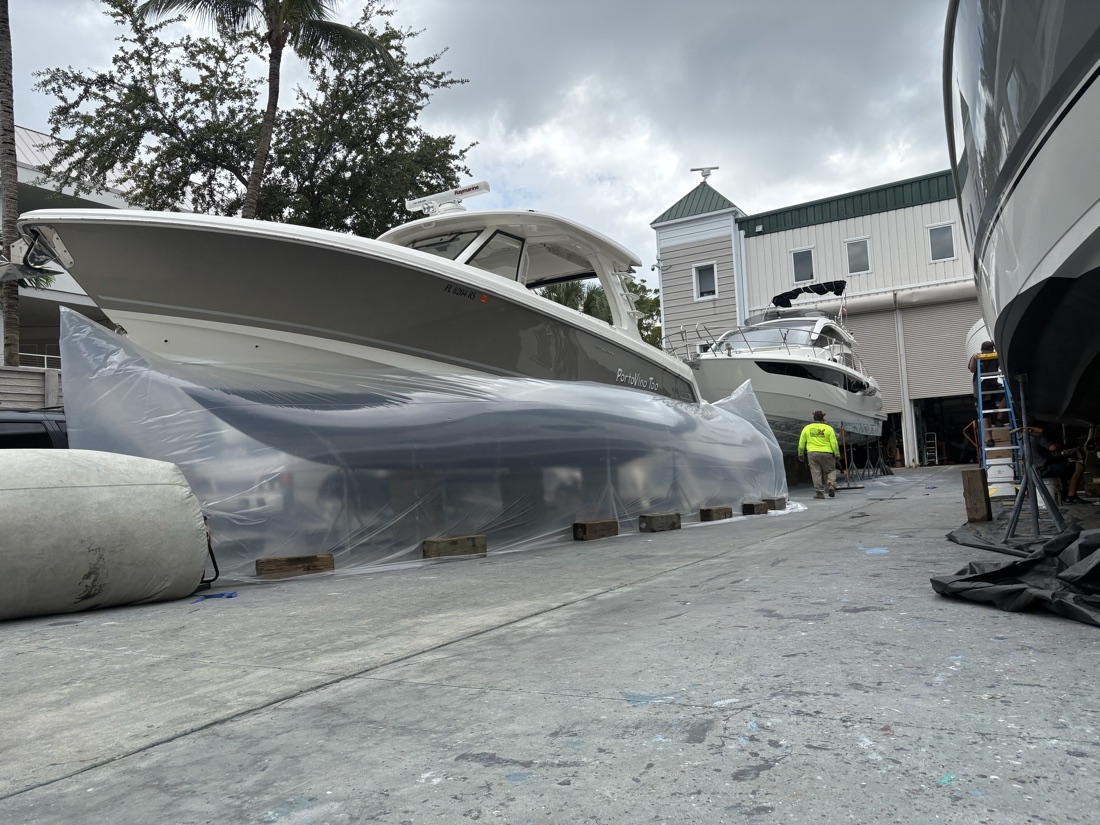
Yes, with the right media. Gelcoat is thin and you don't want to cut into it, so we reach for soft abrasives — sodium bicarbonate (soda) or fine recycled glass — at lower pressure. Soda is friable: it shatters on impact and releases its energy lifting the coating instead of carving the surface beneath. That makes it a go-to for boat bottom paint removal where the goal is to take off antifouling without thinning the laminate.
This matters a lot here on the Gulf. Boats hauled at Marco Island and Fort Myers yards carry years of built-up bottom paint, and salt air keeps the corrosion clock ticking. Strip it clean, leave the gelcoat intact, and the hull is ready for fresh antifouling the same week — that's the difference between blasting alone and the full prep-and-coat job. Push too hard with the wrong abrasive, though, and you'll burn straight through the gelcoat into the glass underneath. That's an expensive structural repair you never needed, all from a setup that was too aggressive for a soft, thin surface.
What about aluminum and thin sheet metal?
Aluminum and light-gauge steel are where heat becomes the enemy. These metals are soft and thin, so an aggressive media at high pressure can dish a panel or warp it from friction heat before you ever notice. The fix is technique as much as media: lower pressure, a softer or finer abrasive, a wider standoff distance, and constant nozzle movement so no single spot soaks up heat.
Crushed glass and fine garnet both work well on aluminum when dialed back, leaving a clean profile without stretching the metal. Steel can usually take a harder, faster-cutting abrasive, which is exactly why the two metals get handled differently even on the same job. For trailer frames, undercarriages and automotive work, mixing thin body panels and thick frame steel on one vehicle is common, so the operator adjusts pressure and standoff as they move across it. Knocking rust off a frame calls for more bite than feathering paint off a fender, and a good crew reads that on the fly.
Can you blast wood, concrete and masonry?
You can, and it's often the cleanest way to do it — but each behaves differently. Wood is soft and grainy, so soda or fine crushed glass at low pressure lifts paint and grime while leaving the grain; too much abrasive will fuzz or carve it. Concrete and masonry are tough but porous, and the risk isn't damage so much as over-profiling — opening the surface more than your coating needs.
Down here that shows up most on lanais, pool decks and paver driveways. Stripping failed sealer or old paint off a paver driveway takes a controlled touch so you don't blow out the joint sand or scar soft pavers. If you've got a coated patio or block wall, the same care applies — and dustless setups help keep the dust and water managed on a residential lot. The method you pick changes the result here, which is why we walk through dustless vs sand vs soda blasting for surfaces like these.
How does the operator keep your surface safe?
The short version: they don't guess. A careful crew starts with the material, picks a media and pressure to match, and then proves it on a small spot before opening up. Here's the rhythm of a job done right:
- Identify the substrate — gelcoat, aluminum, steel, wood, concrete — and its thickness.
- Choose the media by hardness, then set air pressure on the low side.
- Run a test patch on your actual surface and inspect the result.
- Adjust pressure, standoff and angle until the coating lifts cleanly.
- Keep the nozzle moving to avoid heat, gouging and uneven profile.
That test patch is the cheapest insurance you'll ever buy. It's also why the method matters — dustless, soda and traditional dry setups each behave differently, as we cover in dustless vs sand vs soda blasting.
Why does a safe blast lead to a better coating?
Prep isn't just about not hurting the surface — it's about setting up the coating to last. The right blast leaves a clean, evenly textured profile, and that texture is what paint, powder coat or antifouling grip onto. Too smooth and the coating peels; too rough and you waste material filling valleys. Dialed in, you get the anchor pattern the coating actually wants.
We don't just blast — we prep and coat. A safe blast and a sound finish are the same job, not two.
That's the real reason matching media to substrate matters: a surface you protected during stripping is a surface that holds its new finish through Gulf humidity and salt. Whether it's a hull, a frame or a driveway, the path runs the same way — blast it, prep it, coat it. When you're ready, a quick on-site estimate sorts out the right approach for your exact material.