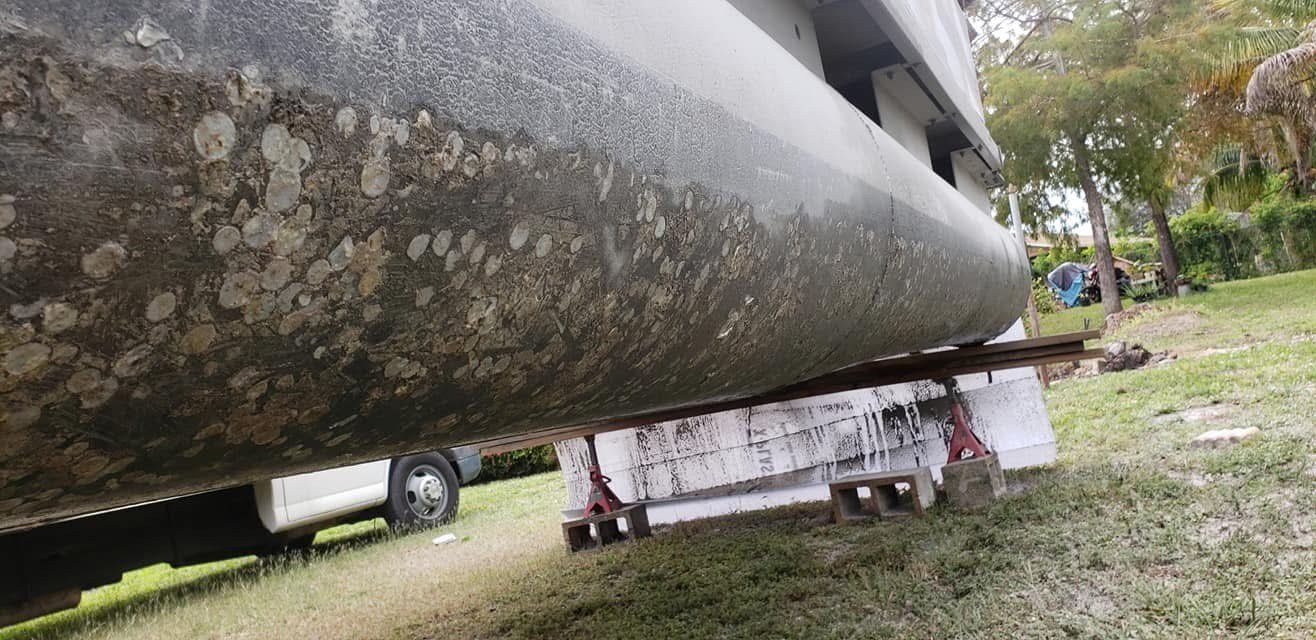
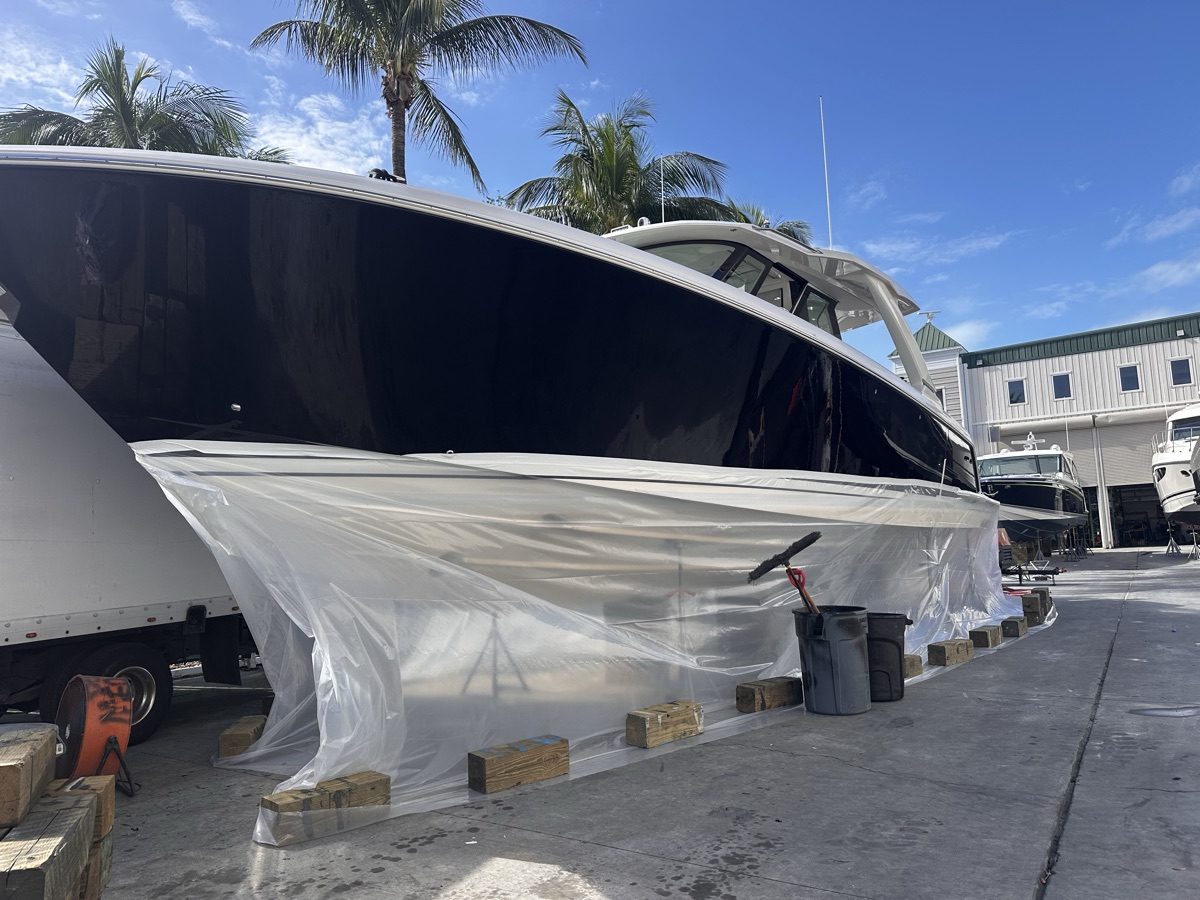
Boats in Estero live in three places: on a trailer in the driveway, on a lift behind the house, or on stands at a yard. Where yours sits changes the containment plan far more than it changes the blasting.
The blasting is the predictable part. Staging is what changes address to address in Estero. A boat on a trailer in a driveway is the simplest version: the truck parks, the hull gets draped and masked, drop cloths go underneath, and everything that comes off lands where we can collect it. A screen cage, a pool or a neighbor's motor court a few feet away means heavier masking and a wet stream so nothing travels.
A boat on a lift behind a home on the Estero River is a different problem, because open water is right there and the work is happening over it. Containment gets designed before anything else: what gets draped, where rebound falls, how spent media and chips are caught rather than dropped. Wind gets a vote too. If it is pushing the wrong direction, we reposition or reschedule instead of blasting toward the water.
At a yard or dry storage the facility usually hands us its own rules about tarping, containment and cleanup, and we work to whatever they hand us. We are licensed and insured and will put surfaces, media and the containment plan in writing if a yard or an association wants it on paper. Tell us which of the three situations you are in when you call, because that is the part that shapes the estimate.
Estero reaches the water through the Estero River and out into the shallow back bay rather than deep Gulf frontage, so the fleet here leans toward bay boats, center consoles, pontoons and trailered hulls. Shallow, warm, brackish water is not gentler on a boat than open water. It is friendlier to growth. Slime comes first, then hard barnacle growth on running surfaces, then a stubborn band at the waterline that scrubbing does not lift.
Underneath that, ablative bottom paint has usually been recoated season after season without anything ever being removed. Layers stack, then check and flake, and eventually new paint is only bonding to old paint that is already letting go. That is the point where recoating is throwing good work after bad, and the whole film has to come off so the next system starts on sound gelcoat.
How fast any given boat gets there depends on how much it runs, how long it sits and how many coats are already on it, which is why the honest answer is a look at the hull rather than a number of seasons. Signs bottom paint needs to come off walks through what to look for, and how often bottom paint gets redone covers the cycle.

People use the two terms as if they mean the same thing. Marine blasting is everything on and around a boat that needs coatings, corrosion or growth removed: hull sides and topsides, bare aluminum, steel, transoms and brackets, shafts, struts, rudders, trim tabs, hardware, plus the trailer or lift holding the whole thing up.
Bottom paint removal is the specific job below the waterline, taking a stacked antifouling system off so a fresh one can go on properly. If that is the piece you actually need, boat bottom paint removal goes deeper on it, and when new antifouling is going straight back on, prepping a hull for new antifouling explains what the surface has to look like first.
Plenty of boats want both halves in one setup. Bottom stripped, then the trailer frame, the brackets and the hardware handled while the rig is already staged and the masking is already up. Grouping the work costs less time than splitting it across two visits and saves staging the boat twice. Mention every item at the estimate rather than after we start packing up.
A hull is a laminate with a thin cosmetic layer over structure, which makes it the least forgiving thing we work on. The abrasive has to be aggressive enough to break the bond holding old paint on and gentle enough to stop when it reaches gelcoat. That is a media and pressure decision, not a matter of simply moving slower.
Baking soda is the soft end and suits gelcoat, thin aluminum, outdrives and intricate hardware, because it releases coatings without cutting into the substrate. Crushed recycled glass and garnet come out for steel, heavy scale and trailer frames where corrosion has real depth. The wet dustless setup is the one we lean on near water, since water in the stream drops the dust, knocks chips down instead of letting them drift and keeps the panel from getting hot.
We test a small area and look at what is under the coating before running a whole hull. Previous repair work, soft laminate or a blister field shows up in that test patch, and the plan changes right there rather than halfway down the boat. Soda versus sandblasting a boat hull lays out the tradeoff in plain terms.

The hull gets the attention and the metal under it gets ignored until something seizes. A lift on the Estero River sits over brackish water every hour of the year: motors, cables, cradles, beams, bunk brackets and fasteners corroding quietly while the boat above them looks fine. Davits and dock hardware take the same exposure.
Trailers fail differently. Salt gets inside the frame tubing through drains and open ends, so scale grows from the inside out and the first visible clue is a bubble in the paint over metal that is already thin. Springs, axles, brackets, coupler and fender mounts follow. We blast frames back to clean steel and can prime or coat them before we leave, which matters here because bare metal in Estero air does not wait politely. Heavier corrosion work is on the rust removal page.
After stripping, you get clean, uniformly profiled material and a decision: bare and ready for your yard, painter or bottom paint applicator, or carried through to a coated surface while the profile is fresh. The estimate moves with hull length, how many layers are coming off, the condition of the gelcoat underneath, how much hardware and trailer work comes with it, access and containment, and whether coating follows. Looking is free. Call or text (239) 227-1768, see the rest of what we cover in Estero, or compare how the same work runs on our Naples marine blasting page.
Based in Naples and mobile across Southwest Florida — we bring the rig to your home, marina, yard or job site. Call or text (239) 227-1768.
We come to the boat. The rig is self contained and sets up in a driveway, a side yard, a backyard or a yard slot, so a hull does not have to be hauled somewhere just to be stripped. What we need to know first is how the boat is supported, how close open water is, and whether a truck can reach it. If a lift or a set of stands leaves the bottom unreachable, you hear that at the estimate rather than on the day.
Not when the media and pressure are right, and that is the entire skill of hull work. Soda and the wet dustless setup sit at the gentle end specifically so coatings release before the gelcoat gives up anything. We test a small area, look at what is under the paint, then run the hull. If we find soft laminate, blistering or previous repairs, we adjust or stop and tell you exactly what we are seeing.
Containment gets planned before the first pass on any waterfront setup. The hull is draped and masked, drop cloths go underneath, and we run wet so spent media and chips fall rather than drift. We work out where rebound lands ahead of time and collect what comes off instead of leaving it in the grass. If the wind is pushing toward open water, we reposition the setup or move the day.
Bottom paint removal is one job inside marine blasting. The wider service covers hull sides, aluminum, steel, running gear, hardware, trailers, davits and lift components as well. Bottom paint removal is specifically the layered antifouling below the waterline coming off so a new system can bond to sound material. Many boats need both in one visit. See boat bottom paint removal for the narrower version.
Yes, with the right media. Aluminum is soft, and thin sheet distorts if it gets hot, so it gets soda or a wet approach rather than an aggressive cutting abrasive. Bare aluminum also wants a specific profile if a coating is going over it afterward. Tell us what the piece is and whether it is getting coated, and the setup gets chosen around that instead of around whatever was already in the pot.
Yes. Running gear, shafts, struts, rudders, trim tabs, brackets, outboard mounts and through hull hardware get the same treatment as the hull, matched to the metal each piece is made of. Small intricate items usually get soda so threads, edges and castings are not chewed. If parts are coming off the boat, set them out before the day so they are ready when the rig arrives and everything happens in one setup.
We quote after we look at the boat, not before. What moves the number is hull length, how many layers of paint are stacked on the bottom, the condition of the gelcoat underneath, how much hardware and trailer or lift work comes with it, how tight the access and containment are at your address, and whether you want it coated after the strip. On-site estimates are free. Call or text (239) 227-1768.
We bring the rig to the driveway, the lift or the yard, and containment gets planned before anything runs. Call or text (239) 227-1768 for a free on-site estimate in Estero.
Tell us a little about the job and we'll get right back to you.
Thanks — we'll be in touch shortly to set up your free estimate.