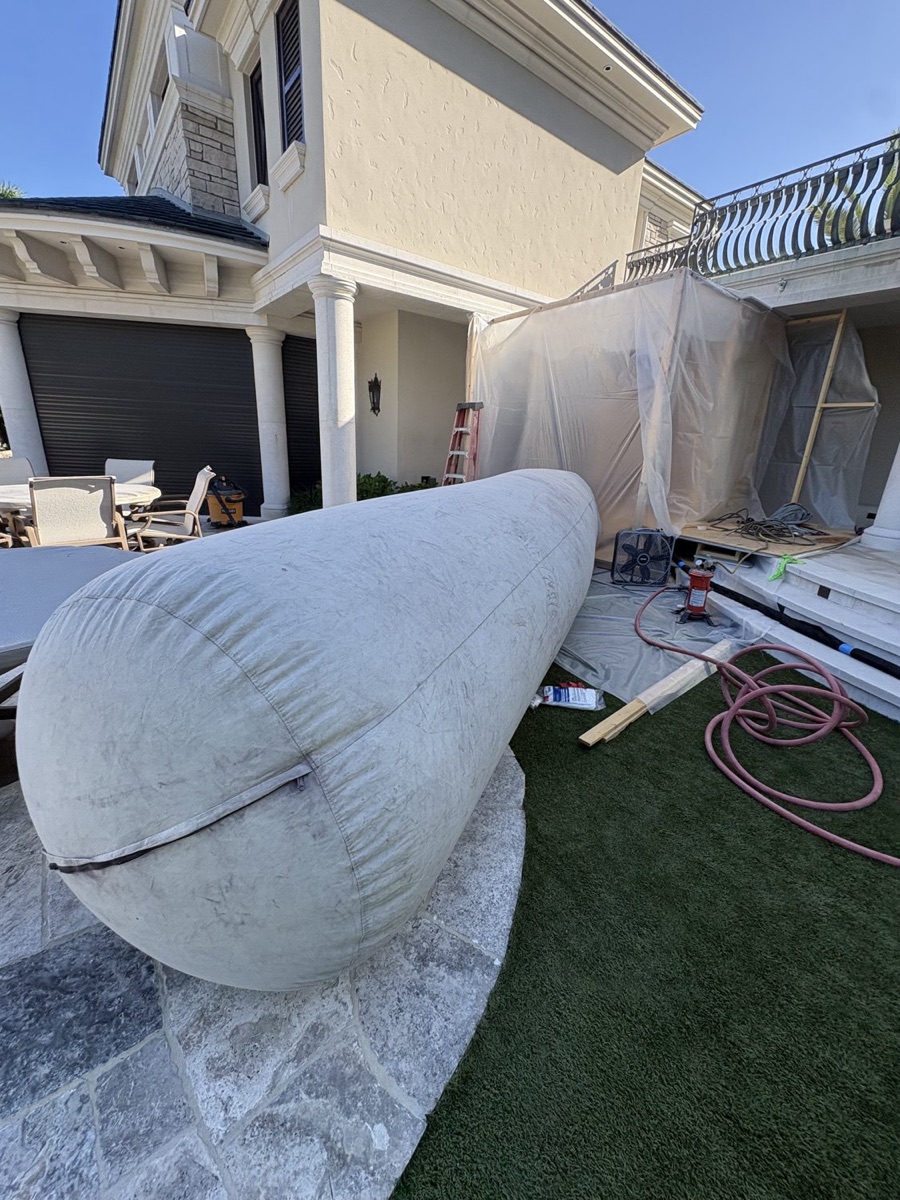
The hull gets the attention, but around Fort Myers it is usually the metal surrounding the boat that quits first: the trailer frame, the lift beams, the davits, the shafts and struts, the tower and the rail. We blast that where the boat already sits.
SWFL Media Blasters works on the metal that surrounds a boat, at the boatyards and marinas that line the Caloosahatchee in Fort Myers, at the dry storage lots off the river, and in canal side backyards and driveways out toward Iona, McGregor Boulevard and Fort Myers Shores. Trailer frames, lift beams and davits, shafts and struts, aluminum towers and pontoon logs, cleats, rails, gates and dock steel all corrode in brackish river water upriver and open salt down through San Carlos Bay, and they corrode in the places a wire wheel cannot reach. Bottom paint is its own job with its own page, stripping Fort Myers hulls back to gelcoat. Everything else marine is this one. Call or text (239) 227-1768.
A lift, a davit set or a dock frame sits in the worst spot on the property. Splashed, baked, splashed again, and never fully dry. Corrosion starts where the coating or the galvanizing got broken during install and never got touched up: bolt holes, U bolts, cut ends, weld seams, cable sheaves and the brackets holding the bunks. By the time a beam looks rusty from the seawall, the scale has been working underneath the paint for a good while.
Blasting is what actually ends that, because it reaches into the pitting and the seams instead of skating across the top of them. We take beams, cradles, walkway frames, ladders, davit posts, gates, rails and the hardware bolted to them back to sound metal, so a new coating goes onto something it can hold. Paint over scale and you are buying a season, not a repair.
Fort Myers gives that metal a double dose. Docks and lifts upriver toward Fort Myers Shores sit in brackish Caloosahatchee water, and the same style of frame on a canal off Iona or downriver toward San Carlos Bay is taking real salt. Either way the corrosion is a process, not a stain, which is the argument made in full on our rust removal page.
A boat trailer gets backed into salt water, pulled out and parked. Water finds its way inside the frame tubing through vent holes, drain holes and open ends, and then it stays there. Meanwhile the springs, axles, U bolts, hangers, fenders, brake hardware, hubs, the tongue and the coupler each rust on their own schedule, and the paint on top of the frame is usually the last thing to admit it.
Blasting is also how you find out what is left. Once the flaking paint and loose scale come away, sound steel looks like sound steel and a thin spot looks like a thin spot, which is information worth having before a boat goes back on the bunks rather than after. Then the frame gets coated while it is clean and dry, and the whole thing starts over from a known point instead of another layer of guesswork.
Trailers are easy work in a Fort Myers driveway, a storage lot or a boatyard, and the best time is when the boat is already off, which usually means while it is out for bottom work anyway. Coastal trailer and truck corrosion in general is covered in rust removal on trucks and trailers in coastal Florida, and the town wide version is rust removal in Fort Myers.
Aluminum does not rust, which is why people leave it alone until it looks terrible. It oxidizes, chalks, streaks and pits instead, and it does that fastest where salt gets trapped in a seam and where stainless fasteners sit against it. Pontoon logs go dull and grow a band at the waterline. Towers, T top frames, hardtop legs, radar arches, outriggers, rails and gate frames chalk out in the sun until the anodizing or the paint is doing nothing at all.
The catch is that aluminum is soft and often very thin. Wrong media at the wrong pressure will emboss a tower leg or open up a pontoon skin, and that is a real repair, not a cosmetic one. So the setup backs down to the softest approach that still lifts the coating. Baking soda handles oxidation and light finishes on thin wall material without cutting the metal underneath, crushed recycled glass takes a heavier coating where the section can carry it, and pressure is set to the panel with a test spot first.
The differences between the two substrates are worth reading before you decide: blasting aluminum versus steel lays them out. When gentle is the whole requirement, the job is soda blasting.

Under the waterline, running gear collects everything the water has to offer. Shafts, struts, rudders, skegs and trim tabs come up carrying calcium, hard growth, overspray from bottom paint jobs going back years, and in a lot of cases paint that was never supposed to be on them in the first place. Blasting pulls all of it off at once and hands the piece back with clean, honest metal showing, so anything that needs attention is visible instead of buried.
What we are is the prep. We strip, clean and can coat. Machine work, balancing, bearing replacement and anything structural stays with your yard or your machinist, and it is a lot easier for them to quote a shaft or a strut they can actually see.
Above the waterline it turns into a parts job. Cleats, chocks, hinges, hatch frames, anchor pulpits, bow rails, bimini and tower hardware, engine brackets, thru hull fittings, latches and every stainless piece that has gone dull or picked up staining. Pull them, bag them, and they go through in one setup, which is far faster and far less labor than fighting each one on the boat. Then they get handed back bare or coated. The full range is on the marine blasting page.
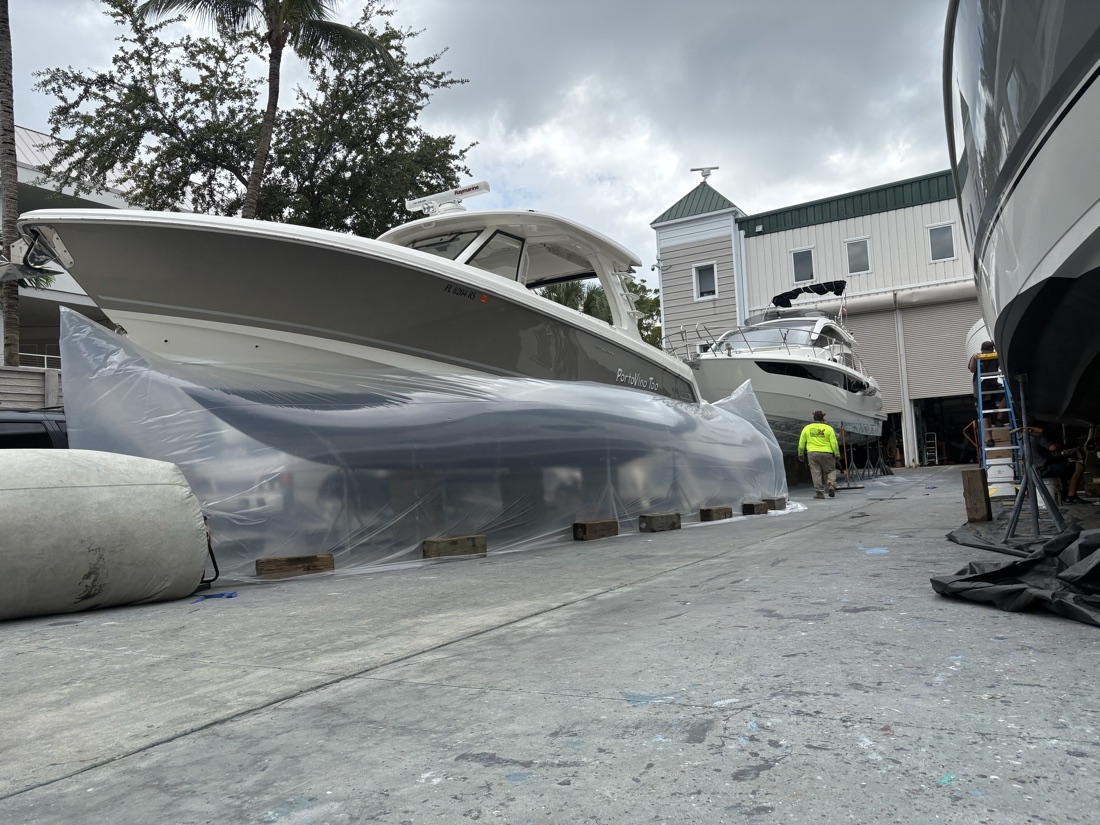
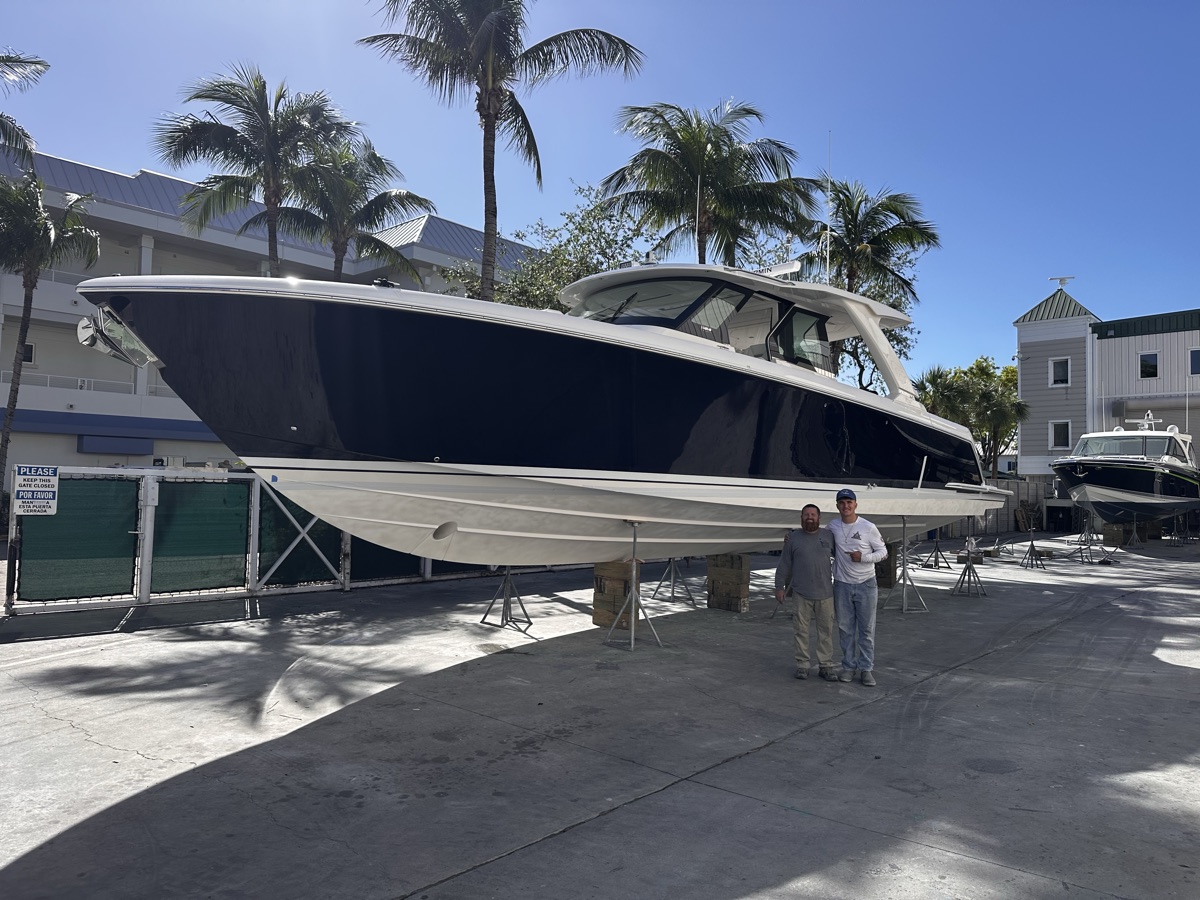
The rig goes to the metal: river marinas and boatyards in Fort Myers, dry stack and storage lots, commercial and contractor yards, canal side backyards and driveways toward Iona and Fort Myers Shores, and properties east along Palm Beach Boulevard. Our needs are simple. The piece has to be reachable and sitting on blocks or stands, the truck needs a parking spot close enough for the hose to reach, and there has to be a clear route in. The rig covers Lee and Collier County, so the location itself is seldom an obstacle.
Containment is planned before anything runs, because this work happens next to water, next to other people's boats and usually within sight of a neighbor. Surfaces that stay get masked and draped, the ground gets tarped so rebound and spent media land where we can collect them, and the area gets cleaned before we pull out. When dust has to stay put, next to other boats on stands or inside an open shop bay, the wet dustless setup does the work, and fines fall right at the nozzle instead of traveling across the yard.
Then there is timing. Freshly blasted steel in Fort Myers river air begins to flash on its own, so the coating decision belongs at the estimate rather than a week later. Pieces can go back to you bare for your yard or painter to finish, or we prime and topcoat them while the profile is still clean and dry. The job is sized by how many pieces there are and how much surface they carry, how deep the corrosion has gone, what the metal is, how the rig reaches it, what has to be contained, and whether we coat afterward. The rest of what we do around town lives on the Fort Myers page; the same service one town south is marine blasting in Estero. Call or text (239) 227-1768 for a free on-site look.
Based in Naples and mobile across Southwest Florida — we bring the rig to your home, marina, yard or job site. Call or text (239) 227-1768.
We come to you. The rig travels to marinas and boatyards up and down the Caloosahatchee in Fort Myers, to dry storage lots and commercial yards, and to private driveways and canal side backyards. We need the piece blocked or supported so it cannot shift, a spot for the truck near enough that the hose reaches, and a walkable path to it. Say where the piece will be when you call, and the setup gets planned around that.
For a proper job on the frame, yes. With the boat sitting on the bunks, the top of the frame, the crossmembers and the areas around the bunk brackets are exactly where the water has been sitting and exactly where we cannot get. If the boat is already hauled for bottom work, that is the natural time to do the trailer, since it is off anyway and the setup is already there.
Not when the media and pressure match the material. Aluminum is soft and often thin walled, so an aggressive setup can emboss or open it. We drop to baking soda for oxidation and light finishes, use crushed recycled glass only where the section can carry it, set pressure to the panel and test an area that will not show before committing. See blasting aluminum versus steel for what changes between the two.
It depends on the setup, and that is what the free on-site look is for. Anything that can be unbolted and worked on solid ground is cleaner, faster and easier to contain. Where a frame has to be blasted in place, we build containment underneath and around it, drape what stays and collect the media rather than letting it go into the canal. If a location cannot be contained properly, we will tell you that instead of starting.
Those are routine. Blasting takes off calcium, hard growth, bottom paint overspray and old coating in one pass and leaves clean metal you can inspect. Media is matched to the alloy, and delicate or intricate pieces get the softest setup we run. We handle the stripping and the coating side. Balancing, machining and structural repair stay with your yard or machinist, and they are much easier to quote on a part that has been blasted clean.
No, they are neighbors. Bottom paint removal is the hull itself, stacked antifouling taken back to sound gelcoat, and it has its own page: bottom paint removal in Fort Myers. This page is everything else metal on and around the boat, the trailer, the lift and davits, the dock steel, the running gear, the hardware and the aluminum. If the boat is already hauled, that is a natural time to handle both.
Call or text (239) 227-1768 and tell us what the metal is, roughly how much of it there is, and where it sits in Fort Myers. The on-site estimate is free. Scope comes down to piece count and surface area, the substrate, how far corrosion has traveled, access and containment at the location, and whether you want us to coat it on the spot or leave it bare for another trade.
We bring the rig to the boatyard, the dry storage lot or the canal side driveway where it already sits. Free on-site estimates in Fort Myers, call or text (239) 227-1768.
Tell us a little about the job and we'll get right back to you.
Thanks — we'll be in touch shortly to set up your free estimate.