Baking soda is the soft end of the media rack. It shatters on impact, lifts coatings off gelcoat, aluminum and wood without cutting a profile into them, and rinses away with water. On a tight island lot, that last part counts.
SWFL Media Blasters runs soda blasting on Marco Island, and soda is what you pick when the thing under the coating is worth protecting. Sodium bicarbonate is soft. It shatters against the surface instead of biting into it, and that fracture spends its energy sideways, under the paint, rather than downward into the material. Gelcoat keeps its gloss. Aluminum keeps its thickness. Wood keeps its grain instead of getting carved. Because soda dissolves in water, the residue rinses away rather than embedding itself in every seam and screen track. On an island of canal lots, boat lifts, screened lanais and neighbors a few steps away, that cleanup profile is worth nearly as much as the stripping. Call or text (239) 227-1768.
Every other abrasive works by cutting. Crushed glass and garnet are hard, angular and heavy, and they take material with them, which is exactly what rusted steel needs and exactly what you do not want happening to the gelcoat of a boat that lives on a Marco Island lift. Soda works by fracturing. The particle breaks apart when it lands, and the energy of that break travels along the surface, getting under the coating and popping it loose without driving a crater into what is beneath.
Two consequences follow. First, soda leaves little or no anchor profile, so it is a stripper rather than a surface prep in the industrial sense. If the next coating needs a mechanical profile to grip, soda by itself will not create one and something else has to. Second, soda runs cool and does not dump heat into light material, so thin panels and aluminum come through flat instead of oil-canned.
The third point is chemistry and it deserves saying plainly: soda is alkaline, and the residue has to be rinsed off thoroughly before anything is coated, or adhesion suffers. That rinse is part of the work, not an extra. The three media are compared in dustless versus sand versus soda blasting.
Marco Island builds outdoor living into the house. Tongue and groove ceilings over the lanai, exposed beams and rafter tails, pergolas, cypress and pine soffits, dock and deck framing, and trim on the older island homes that has taken decades of sun and salt spray. Wood in this climate goes gray, then gets a coat of something, then gets another coat rolled over that, and eventually somebody wants the actual wood back.
Soda suits that work because it takes finish off without sculpting the surface. Wood is not uniformly dense: the soft early growth erodes far faster than the hard grain, so an aggressive media leaves a rippled, furry texture that looks like driftwood and takes a lot of sanding to undo. Soda lifts coating and gray weathering while the grain structure stays where it belongs.
The realities are worth knowing up front. Deeply embedded stain does not always release completely, mildew inside the wood is a separate treatment from stripping, and old varnish behaves nothing like latex. We test a panel somewhere nobody looks, show you the result, and adjust before running the whole ceiling. A screened lanai also needs the screen, the cage and the pool protected first, which gets set up before the first pass.
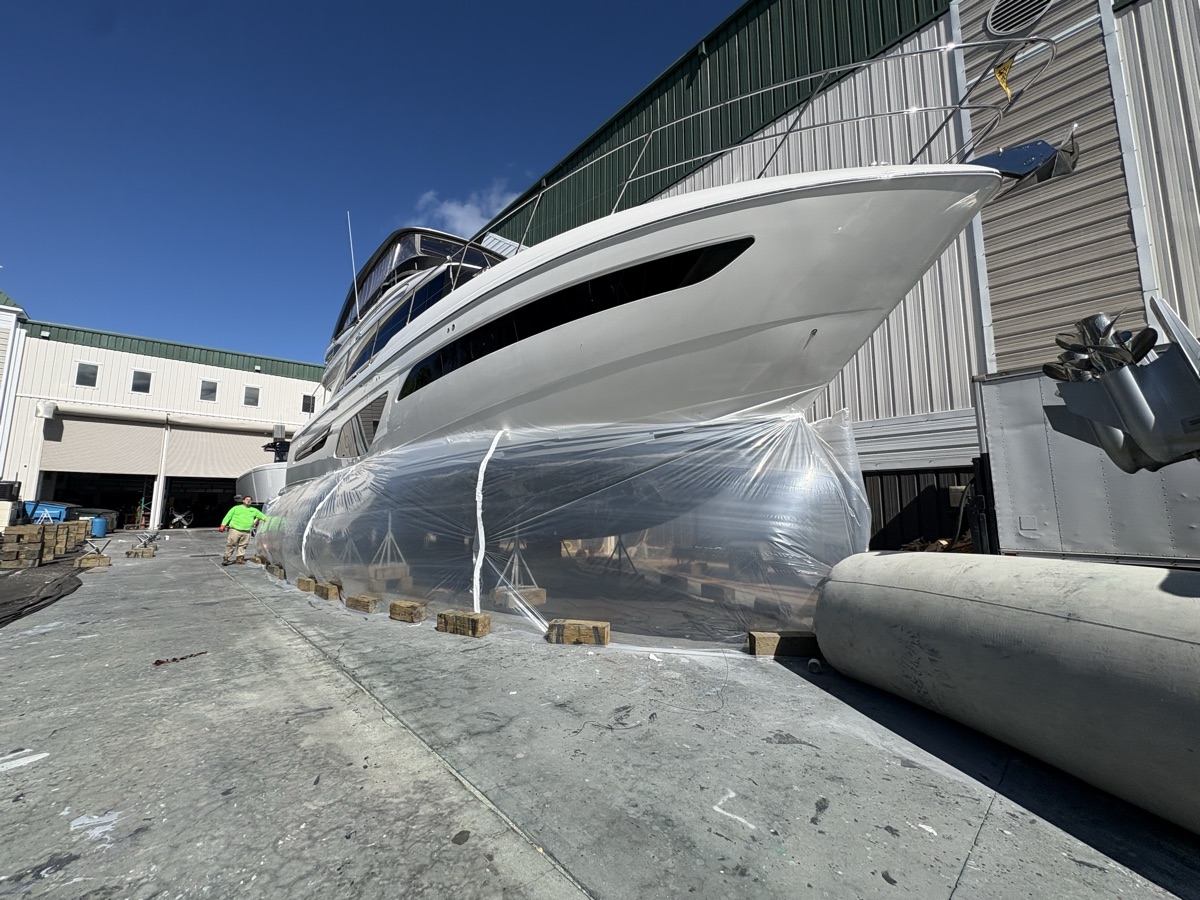
Marco Island runs on aluminum and fiberglass. Boats sitting on lifts behind the house, T-tops and hardtops, rails and rod holders, towers, outboard cowlings and brackets, dinghy hulls, aluminum window and door frames, screen enclosure framing, pontoon decking, and the hardware holding all of it together.
Soda's advantage on this material is that it removes what is on top without measurably attacking what is underneath. Gelcoat comes out of a soda strip with its integrity intact rather than chalked and abraded. Aluminum does not give up thickness or get work hardened by a heavy stream. Cast pieces, vintage trim, carburetor bodies, hinges, latches and anything carrying fine lettering or a maker's mark come out clean with the detail still readable, which is hard to pull off with a harder media and impossible with a wire wheel.
Painted surfaces are the other classic case: an old finish that has to come off something you do not want cut. Soda separates the layers instead of blending them into the base material. Where the piece is headed for a demanding recoat, we will say so if it needs a profile soda cannot produce, and we run a different media for that step rather than pretending one product does everything.

Soda is a specialist, not a default, and using it everywhere would waste your time and ours. It is the wrong media for heavy rust and mill scale, where it polishes and frustrates rather than cuts. It is wrong for structural steel that needs a measured anchor profile for an industrial coating. It is slow going across large areas of thick, stubborn multi-layer paint. And it is not what we would pick for stacked antifouling on a boat bottom, where there is a great deal of hard material to remove and the surface underneath is getting coated again anyway.
For all of that, the rack has better tools. Crushed recycled glass and garnet cut rust, scale and heavy coatings. The wet dustless setup on Marco Island handles thin metal, heat-sensitive panels and any job where dust control is the constraint. Bottom paint has its own page and its own process: boat bottom paint removal on Marco Island.
Picking wrong burns hours and can leave a surface you never wanted touched. We would rather have that conversation at the estimate than halfway through the job, which is what a free on-site look is for. See soda blasting generally, and soda versus sandblasting on a boat hull for the marine comparison.

The island shapes the work before anybody picks a media. Everything arrives over the causeway and down Collier Boulevard, so a rig on the island is committed to the island for the day and staging gets planned instead of improvised. Driveways are short, setbacks are tight, and the strip of side yard between two houses is often the only path to the backyard, the seawall and the lift. Canal-front work happens with water on one side and a pool cage on the other. Condo and HOA properties add shared lots, assigned parking, access rules that vary from property to property, and neighbors close enough that they are part of the plan whether they want to be or not.
What helps us: a clear path to the piece, somewhere to put the truck within hose reach, and water and power at the address where they are available. If the property is managed, we need to know who signs off and how vendor access works there.
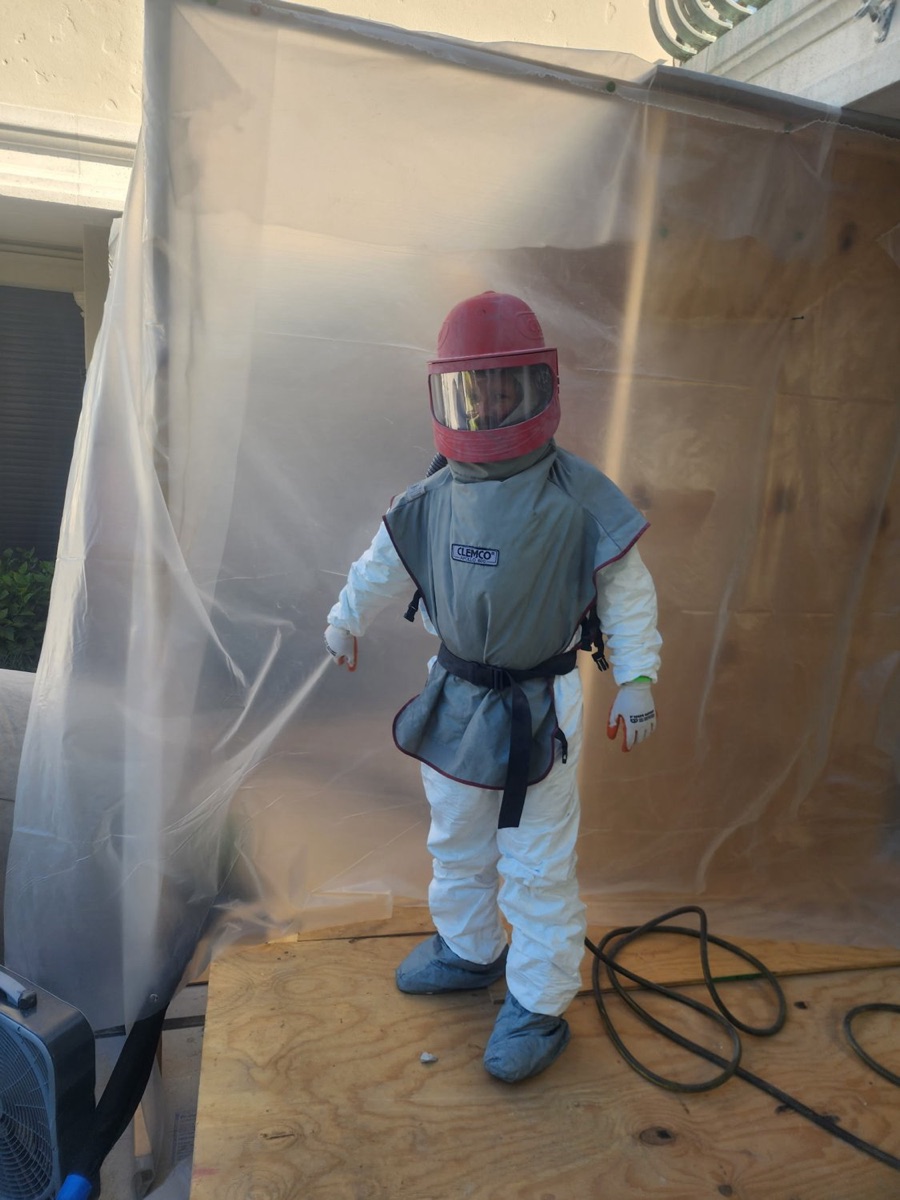
Soda earns its keep in exactly this environment, because water-soluble residue rinses instead of grinding into pavers and lodging in deck joints, screen tracks and the neighbor's driveway. It is still blasting, so we tarp, mask and cover, protect plantings and pool water, and clean up before we leave. For the full island picture, see the Marco Island page.
Based in Naples and mobile across Southwest Florida — we bring the rig to your home, marina, yard or job site. Call or text (239) 227-1768.
That is the reason soda exists as a media. It fractures on impact and releases its energy along the surface instead of cutting into it, so the coating comes off while the gelcoat underneath keeps its integrity and its gloss. Pressure and distance still get matched to the panel in front of us, and we test somewhere out of the way before running the whole surface. Nothing gets committed to on a guess.
This is one of soda's best uses. Wood has soft and hard grain, and a cutting media eats the soft growth faster and leaves a rippled, furry surface behind. Soda lifts finish and gray weathering while the grain structure stays intact. Deep stain does not always release completely and mildew inside the wood is its own treatment, so we test a section and show you what you are actually going to get.
Usually not. Stacked antifouling is a great deal of hard material and the hull is getting recoated anyway, so a media that cuts is faster and more sensible for that job. We would run the appropriate abrasive and protect the gelcoat by controlling pressure, angle and technique instead. The details are on boat bottom paint removal on Marco Island.
Soda is water-soluble, so what settles rinses off rather than grinding into pavers or lodging in deck joints and screen tracks. We tarp and mask before starting, contain the work area, and clean up when the work is done. It is still blasting, though, so there is dust and there is coating debris coming off the surface, and containing that is part of the job on a tight island lot.
Soda is alkaline, so we treat landscaping and pool water as things to protect rather than assume are fine. That means covering beds and equipment, shielding the pool when work is close to it, and rinsing surfaces down afterward. Tell us what surrounds the work area when we come look at the job and we will plan the containment around it.
We come to the island. The rig is mobile, and the point of that is the boat stays on the lift, the ceiling stays on the lanai and the gate stays on its hinges. What we need is a path to the work and a place to stage the truck within hose reach. Tell us what water and power are available at the address and we will plan around what is actually there.
It depends on the surface, the area, how many layers are coming off, how much masking and containment the location demands, and whether a coating follows. Soda is gentler and slower than a cutting media, so it prices out differently than a rust job on a piece of the same size. We do not quote work we have not seen. Call or text (239) 227-1768 for a free on-site estimate.
Gelcoat, aluminum, wood or intricate hardware, stripped where it sits without cutting what is underneath. Call or text (239) 227-1768 for a free on-site estimate.
Tell us a little about the job and we'll get right back to you.
Thanks — we'll be in touch shortly to set up your free estimate.