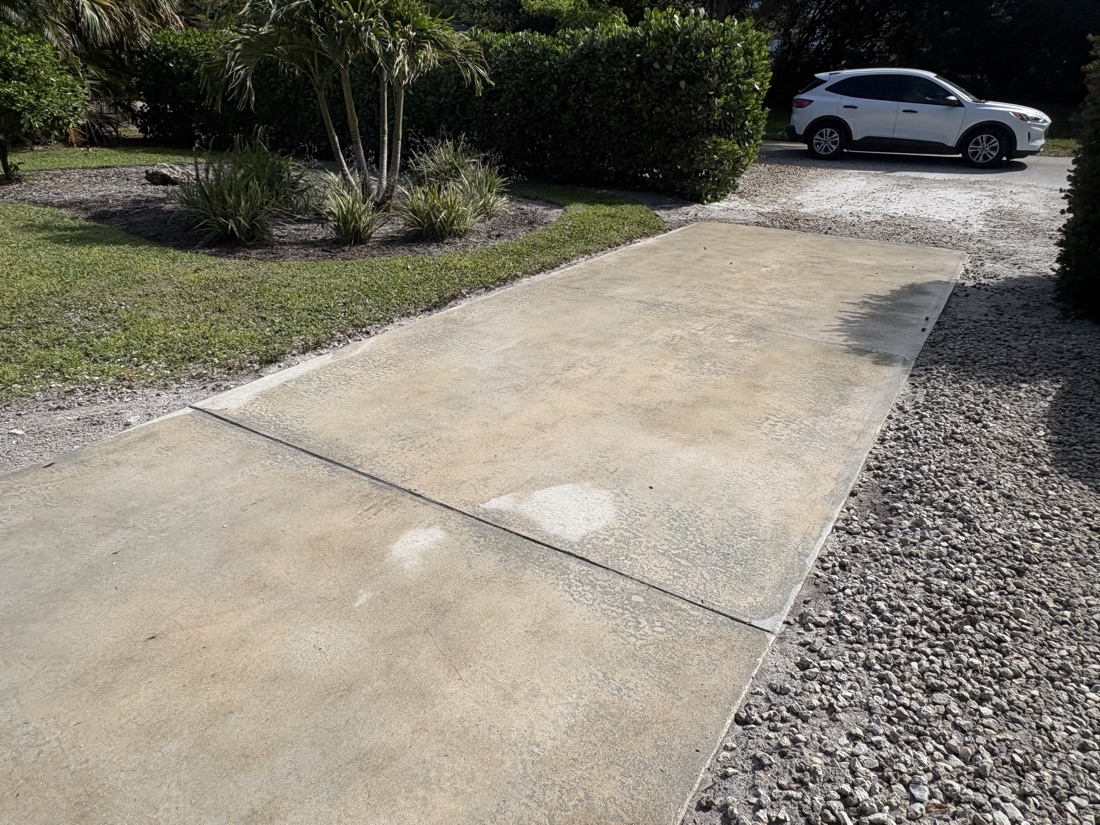
White haze, flaking film, yellowing and a slick pool deck all say the same thing: the sealer has failed. We blast it off brick paver, travertine and stone across Naples so the surface comes back to true color, ready for a fresh, even seal.
Sealer does not fail quietly. The first sign is usually a white or milky haze that appears after rain and never fully dries away, because moisture is trapped underneath the film. Then the film starts letting go: flaking, peeling, patches that read darker or glossier than the rest. Solvent based products often turn yellow or amber under Naples sun, and a gloss sealer that has broken down leaves a pool deck slippery in exactly the place you do not want slippery.
Our climate speeds every bit of that up. Long UV hours, afternoon storms that soak the surface before it has cured or cooled, chlorinated splash off the pool, irrigation running against a driveway edge, and salt in the air near the water. Sealers put on too thick, applied over damp pavers, or layered coat on coat fail the fastest of all.
Once it looks like this, cleaning will not fix it. The problem is the coating itself, and the coating has to come off.
The instinct is to put another coat on and hope it evens out. It does the opposite. The new sealer lays on top of the failed one, so the haze, the trapped moisture and the lifting edges get locked underneath where nothing can reach them. Now two films are fighting each other, the total build is thicker, and the surface is glossier and more slippery than it was before. When that sandwich finally releases, it comes off in bigger sheets.
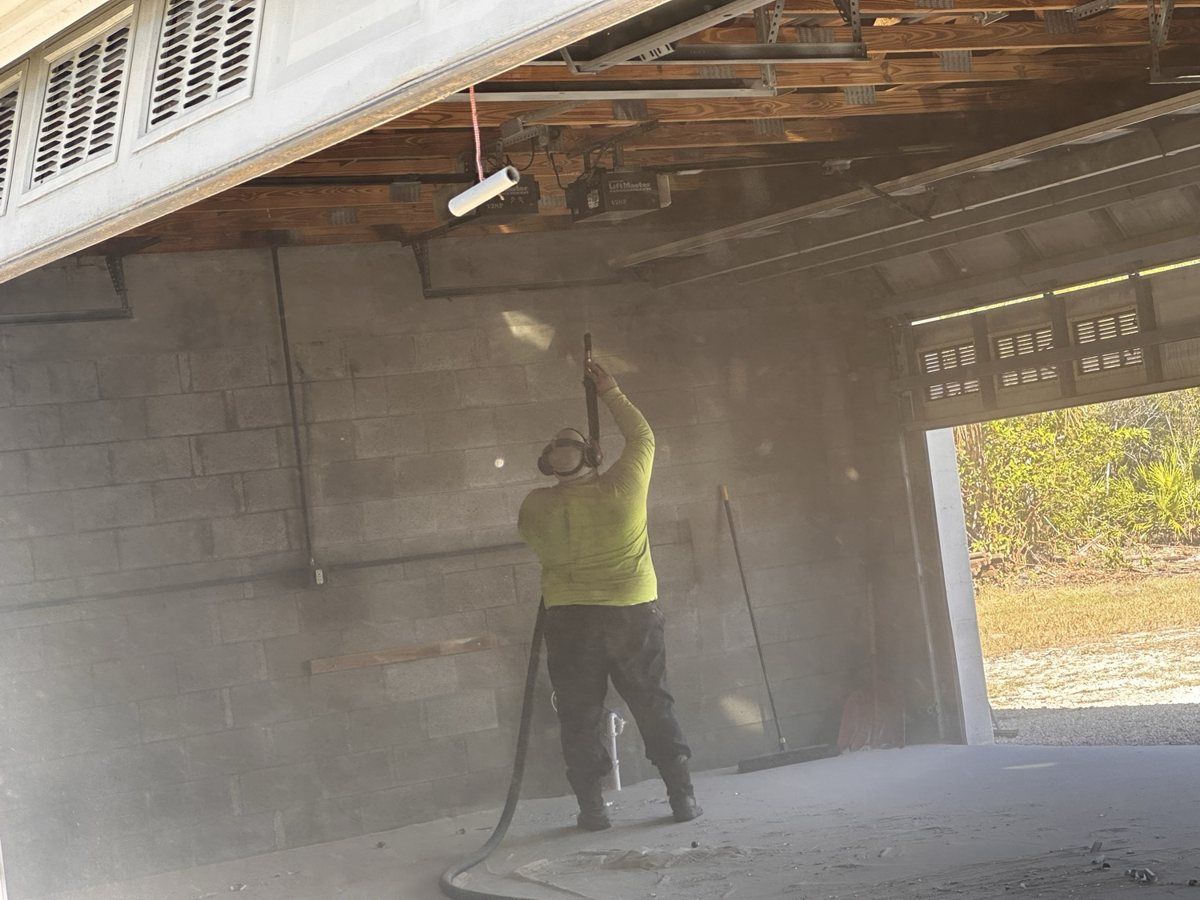
The only real fix is getting the old coating off completely. Media blasting does that mechanically. We take the failed film off paver, travertine or stone without chemical stripper soaking down into your joints and your landscaping, and we can run the wet setup so dust stays down on a tight Naples lot with a screen cage ten feet away.
Background on the process is on our paver sealer removal page and in how to remove old paver sealer.

A Naples driveway and the pool deck behind the same house are often three different materials, and each one wants a different touch. Brick and concrete pavers are hard and take a more aggressive media. Travertine is softer and porous, and its filled and honed or chiseled edge finish has to survive the job. Marble, shell stone and other natural stone are softer still. Stamped and broom finished concrete behaves differently again, and a coquina style surface differently from that.
So we do not show up with one setting. We run crushed recycled glass, garnet, baking soda or a wet dustless stream depending on the stone and on what is sitting on top of it. Then we test a small area out of sight, look at the result together, and only commit to the full deck once you have seen it.
More on that judgment call in is media blasting safe for my surface.
Blasting a paver field disturbs the joint sand, and that is expected. The joints clean out along with the coating, which is generally useful, because old joint sand full of failed sealer, weed growth and organic buildup was never going to support a new seal anyway. Joints get re sanded after the strip, before anything else is applied, and on a polymeric setup that sand has to be installed and activated properly or the new sealer will telegraph every shortcut.
The other thing to expect is honest color. Pavers that had gone gray, cloudy or amber come back to what they actually are, and travertine reads clean and matte again. The surface also needs to dry fully before any sealer goes on, and in our humidity that is worth planning for rather than rushing.
From there it is your call. We can hand it back clean, bare and ready for your sealer contractor, or prep it and coat it ourselves. See also restoring a pool deck or lanai by blasting.
Once the rig is on site, the same setup handles the other coated surfaces around a Naples home: paint on concrete block and stucco walls, garden and privacy walls, columns, planters, garage floors, patios and steps. If a previous owner painted a lanai floor or a pool deck, that comes off too. Details are on our residential blasting page.
Access is usually the first thing to sort out. Gated communities have their own contractor procedures, so tell us what your association needs from us. On a tight lot we need a spot to park the truck and a path for hose to the back. Inside a screen cage we plan containment before anything gets turned on. Seasonal owners often want the work done before they arrive or while the house is empty, and that is easy to build around when we know early.
Cost depends on square footage, the material, how many coats of sealer are stacked up and how badly they failed, access, and whether resealing follows. We look in person and quote it. Call or text (239) 227-1768, or see all of our work around town on the Naples page.
Based in Naples and mobile across Southwest Florida — we bring the rig to your home, marina, yard or job site. Call or text (239) 227-1768.
That haze is moisture trapped under the sealer film, usually because the product went on too thick, went on over pavers that were not fully dry, or has simply broken down after years of Naples sun, rain and pool splash. Cleaning the top does not reach it, because the problem lives under the coating. Removing the failed sealer is the only real fix.
Pressure washing takes off dirt and some loose flakes, but it will not remove a bonded sealer film, and turning the pressure up high enough to try will erode paver faces and blow out joints. Blasting removes the coating mechanically and evenly instead. See pressure washing versus media blasting a driveway.
Not when the media and pressure match the material. Travertine and softer natural stone get a gentler setup than a hard brick paver driveway does, and we always test an out of the way spot first so you can see the result before we take on the whole surface.
It comes out with the coating. That is normal and usually a good thing, because old joint sand loaded with failed sealer and organic growth will not support a new seal. The joints get re sanded after the strip, before any new sealer goes down.
Yes, and it is a common Naples job. We plan containment around the cage, the pool and anything else that needs protecting, and we run the wet dustless setup in Naples so dust does not coat the screens or land in the water.
Either works. We can hand the surface back clean, dry and ready for your sealer contractor, or we can carry it through and seal it ourselves. Blasting is one half of what we do and coating is the other. Decide at the estimate so we schedule the day and the drying time correctly.
It comes down to how much surface there is, the material, how many coats of sealer are on it and how far gone they are, access and containment, and whether resealing follows. We look at the driveway or deck in person before quoting. Call or text (239) 227-1768, and see what drives paver sealer removal cost.
We strip it back to true color anywhere in Naples, with the dust kept down. Call or text (239) 227-1768 for a free on-site estimate.
Tell us a little about the job and we'll get right back to you.
Thanks — we'll be in touch shortly to set up your free estimate.