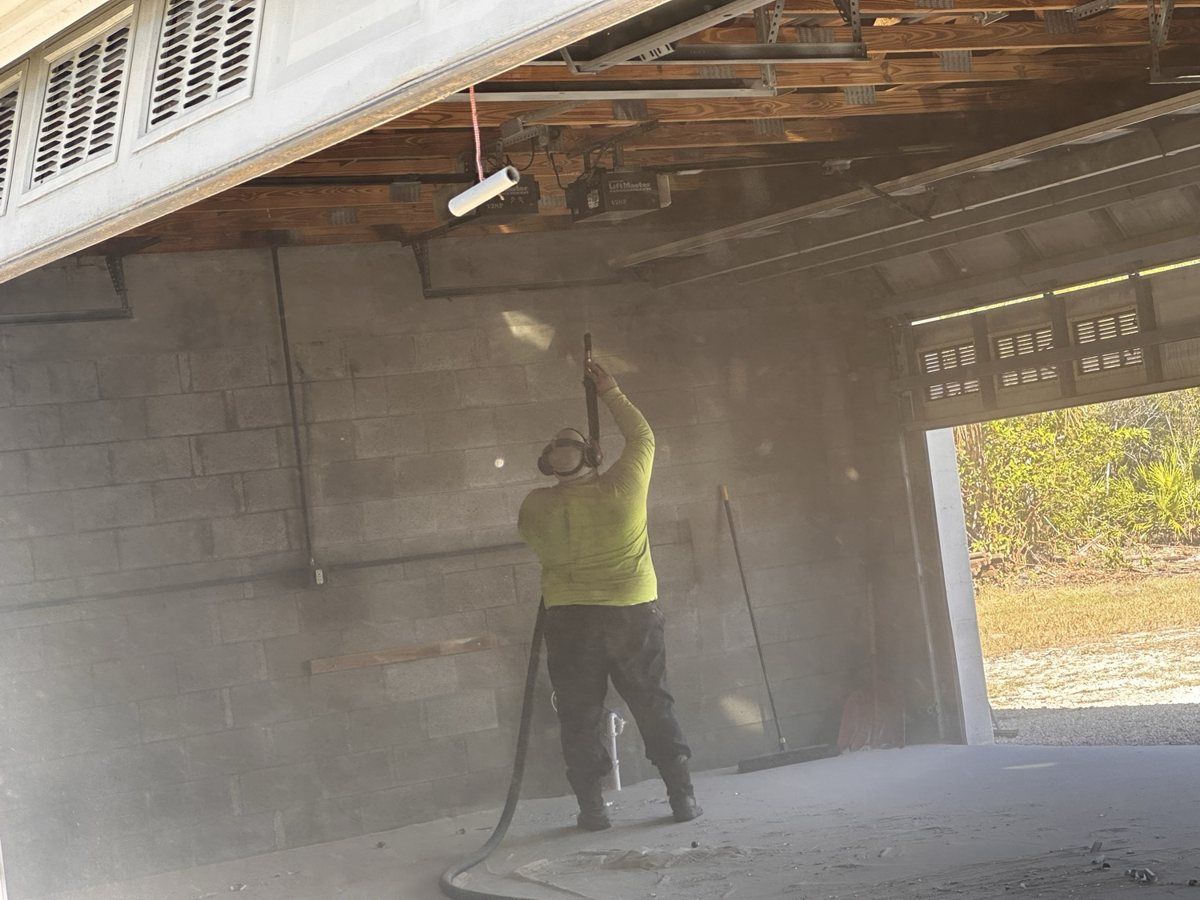
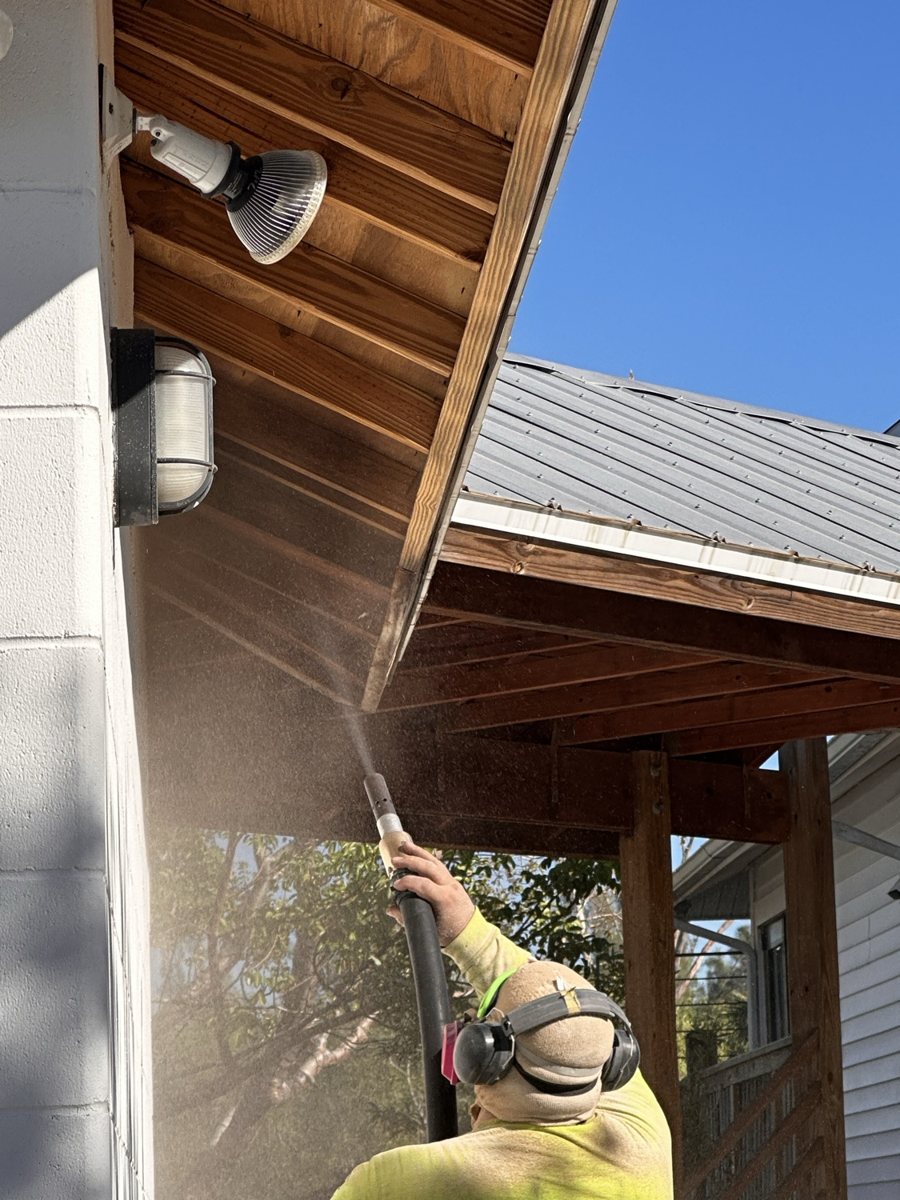
Chalked block, a coated pool deck, a cage frame streaking rust down the kick plate, a wood ceiling that stopped looking like wood. The truck parks in your Fort Myers driveway, the yard gets wrapped, and the surface comes back either bare and ready or primed and coated.
SWFL Media Blasters strips home surfaces in Fort Myers without asking you to bring anything anywhere. The truck parks at the curb or in the drive, the pool deck, the block, the cage framing and the eaves get worked where they stand, and the yard is put back the way it was before we leave. Fort Myers housing runs from riverfront block homes near McGregor Boulevard that have carried paint for generations to subdivisions out past Daniels Parkway that are on their first or second finish. Both end up in the same place eventually: a coating that has let go, and a choice between covering it up again or taking it off properly. Call or text (239) 227-1768 for a free on-site estimate.
Near the river, the houses in Fort Myers are old enough to have real materials on them. Poured and block walls under stucco, cypress and pine in the ceilings and eaves, iron and steel in the rails and window guards, and a coating record that goes back through every owner. Nobody can tell you how many times the west wall has been painted, whether the first coat was oil, or what got smeared into the hairline cracks before the last repaint. Stripping that wall is a dig, and the depth only becomes clear once the first few passes come off.
The subdivisions out east are a different animal. Aluminum enclosures, sealed pavers, coated pool decks and block that has seen one or two coats since the builder left. There is no archaeology to do; there is a single finish that gave up early because the sun, the afternoon storms and the irrigation heads worked on it every day. The strip is shallower, but the surfaces are thinner and less forgiving, which is why the setup matters just as much.
The job description is the same in both places: remove what failed, stop at the material underneath, leave it in a condition the next finish can bond to. What changes is the media in the pot, the pressure at the nozzle and how much of the yard gets wrapped, and every one of those gets decided per surface once we have stood in front of it. The residential blasting pillar describes the service across every town we work; the Fort Myers page lists everything else we do in the city.
Nothing gets blasted until the property has been walked. A stucco wall, a cage upright and a porch ceiling each want a different media and a different pressure, so each one gets its own look. The first passes land on a test spot chosen for being invisible, behind an AC unit or low on a side wall, and you get to see what the surface looks like under the coating before anything on show gets touched.
Then the lot gets read. Hose length from the truck, a spigot and power, and the route to the backyard, which on the close-set lots near the river can mean a side yard barely wider than the hose or a trip through the cage door. Containment is planned around what is nearby, not just what is being stripped: the pool, the screens, the planting beds, the condenser, the grill and the furniture, and, when the neighbor's car is parked a few steps from your wall, the neighbor's car.
The work gets broken into sections so you keep a way in and out while the walls or the deck are in progress, and the spent media gets picked up before the truck pulls away rather than left in the grass. When blowing dust across a fence line is the thing that would stop the job, the water suppressed rig is the answer, and that setup has its own write up: dustless blasting in Fort Myers.

Metal on a Fort Myers house is never dry for long. Upriver it sits in brackish humidity, downriver toward San Carlos Bay it gets salt, and everywhere it gets pool splash, irrigation overspray and afternoon rain. The enclosure shows it first, usually as a stain rather than a hole: an orange run below a screw, a brown line along the bottom rail, a blistered spot where the base channel meets the deck. That streak means the fastener has been corroding under the paint for a while already.
You cannot judge the metal while the paint is on it, and that is the point of stripping it. With the coating and the rust scale gone, you can see which spans are solid and which have lost thickness, and the decision writes itself: coat the sound framing, swap out the sections that are gone, and stop spending money painting over the ones that were never going to hold. Rails, driveway gates, fence panels, the window guards on the older houses, carport posts, a pergola frame and an outdoor kitchen base all fit into the same trip.
The catch with an enclosure is that it is two metals in one assembly: thin aluminum extrusion held together with steel screws and brackets. The aluminum wants the low-heat, non-cutting treatment covered on soda blasting in Fort Myers. The steel wants a media that bites, followed quickly by a coat, since bare steel in this air does not stay bare for long. Why that window is short, and what happens if you miss it, is the entire point of rust removal in Fort Myers; blasting aluminum versus steel goes into why one setting cannot serve both.
Walls are where the square footage is and where a mistake is permanent. Block and stucco will cut under the wrong media or too much pressure, and once the face of a wall is chewed there is no putting it back, so the pressure comes down until the paint releases and the wall stays, and the test spot proves it before the first full wall gets run. What comes off is paint, chalk, elastomeric that has bridged and cracked, mildew-stained texture and, on side walls and fences, the overspray and tagging that nobody put there on purpose.
Flat concrete is the rest of it: a garage floor with epoxy lifting in sheets, a walkway under a paint that never bonded, thinset ridges left behind by a tile job, a pool deck with a topping that has gone blotchy and slick. Blasting takes those off evenly and follows the texture down into the low spots and joints, which a grinder cannot do without leaving swirl and a pressure washer cannot do at all, since it only removes the part that was already coming loose.
Three pages own the deeper versions of these arguments, and this one will not repeat them. Paint on masonry: removing paint from concrete, brick and block. Pool decks and lanais specifically: restoring a pool deck or lanai by blasting. And if what you have is a paver drive gone white or yellow, that is a sealer problem with its own service, paver sealer removal, and its own wash-or-blast question, settled in pressure washing versus media blasting a driveway.

The older Fort Myers houses carry wood that would be hard to replace at any price: tongue and groove porch ceilings, exposed rafter tails, beams, soffits, pergolas and cypress trim. Peeling paint on that wood is a surface problem, and the whole aim is to solve it without turning it into a wood problem. A cutting abrasive on a soft board does exactly that, so the softest media on the truck is the one that goes on wood, and the reasoning behind that belongs to the soda page rather than this one.
Rot is another matter. Blasting exposes rot, it does not cure it, and a board that has already gone punky will not survive an aggressive pass no matter which media is in the pot. When a surface is past stripping, that is what you will be told at the walk-around, not discovered halfway through.
After the strip, you pick the ending. If your painter, sealer crew or carpenter is scheduled, we leave the surface bare and clean and they take it from there; bare block and bare steel should not wait weeks for a finish, so timing matters. If nobody is lined up, we can prime and coat before we pack up, which on the coast is the safer default for metal. The yard is swept, the sheeting comes down and the media leaves in the truck either way. The Bonita Springs version of this page, residential blasting in Bonita Springs, covers the gated-community side of the same work, and cost factors explains what pushes a residential estimate one way or the other.
Based in Naples and mobile across Southwest Florida — we bring the rig to your home, marina, yard or job site. Call or text (239) 227-1768.
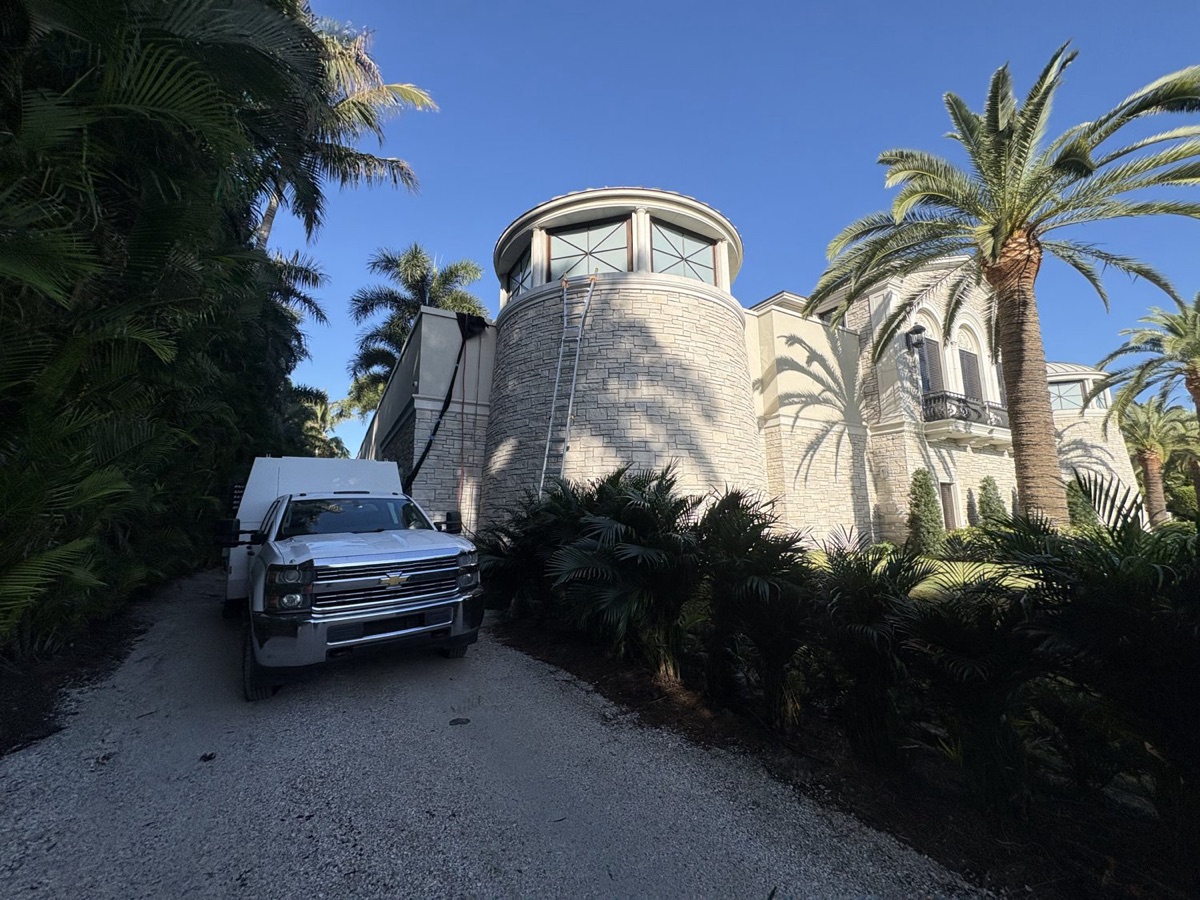
Everything happens at your address. There is no shop to drive to and nothing gets loaded on a trailer; the rig pulls into the driveway and the wall, deck, cage or gate gets stripped in place. Before the visit it helps to know three things: where a truck can park with hose reach to the work, whether there is a spigot and an outlet we can use, and how we get to the back of the house. If your street has gate access or vendor hours, say so and the schedule gets built around them.
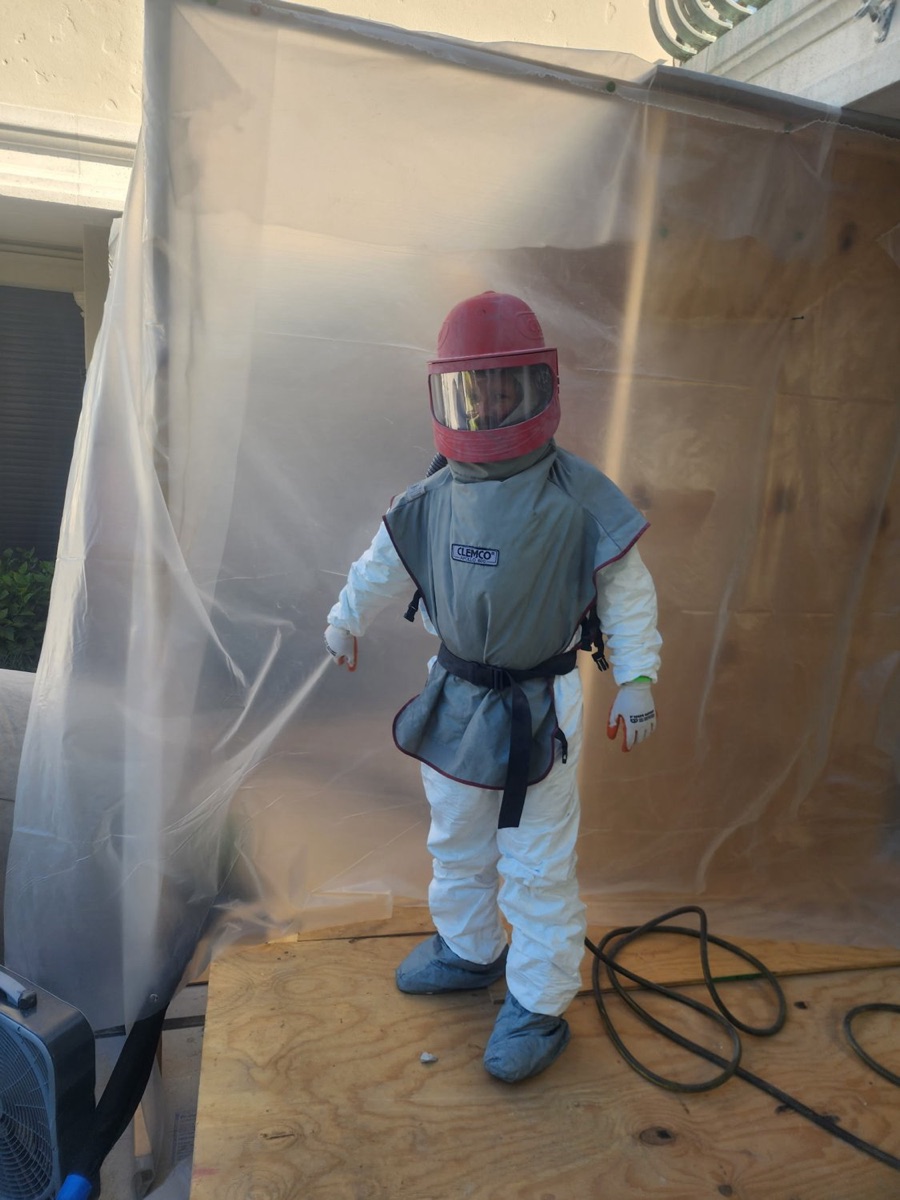
Anything that would rather not be hit with dust or grit: pool water, screen panels, beds and turf, the condenser, the grill, patio furniture and whatever is parked in the drive. On the tight riverside lots that list keeps going onto the neighbor's side of the line, their car and their plantings included. Sheeting and screening go up around the work zone, the passes run, and the media gets collected and taken away in the truck. You are not left with a driveway full of grit to shovel.
It will if it is done carelessly, which is why the setup takes longer than most people expect. Masonry cuts under a media that is too hard or a pressure that is too high, and there is no repair for a wall face that has been eaten into. The answer is a test spot in a hidden place, a setting that is backed off until it releases the paint and leaves the block, and your approval of that spot before a visible wall gets touched. A wall that should not be blasted at all gets that verdict at the walk-around.
Same truck, different service. White haze, yellowing or flaking on pavers means the sealer film has failed, and a failed film has to come off before anything new will stick to the stone. That work is written up separately at paver sealer removal. Bring it up when you call and the drive gets looked at in the same visit as the walls or the pool deck, so you get one estimate for the whole property.
Stripping it is how you get a real answer. Under the paint and the scale, solid metal and metal that has thinned out look completely different, and you can decide span by span instead of guessing from a rust streak. Framing often turns out to be fine and takes a coating that lasts. Some of it is gone, and a screen or welding contractor is the next call. What ends either way is the routine of repainting over rust and buying the same problem back every couple of years.
No. One pool deck, one run of railing, a pair of gates or a single wall is a normal call. Since the truck is already set up at your address, it is worth asking what else could be done in the same trip, because the setup is a fixed part of any visit, but nothing gets added to the scope unless you want it there. Tell us the surface that is bothering you, we scope that, and we mention anything else we noticed on the walk.
Which surface it is and what shape it is in, how much of it there is, how many finishes are stacked on it, how much of the yard has to be wrapped, how the truck reaches the work, and whether you want it coated afterward. A riverside house with a lifetime of paint on the block is a different job from a newer one with one failed coat, at the same footprint. Photos do not settle any of that, which is why the estimate is done standing in your yard. What moves an estimate lays out the factors; call or text (239) 227-1768 to book the free on-site look.
One mobile rig handles the walls, the deck, the rails and the wood at your own address, contained start to finish. Call or text (239) 227-1768 for a free on-site estimate.
Tell us a little about the job and we'll get right back to you.
Thanks — we'll be in touch shortly to set up your free estimate.