Boat Bottom Paint Removal in Southwest Florida: The Full Guide
Every hull eventually carries more paint than it needs. Here is what removal actually involves, from reading the stack at haul out to the bare surface new antifouling has to bond to.
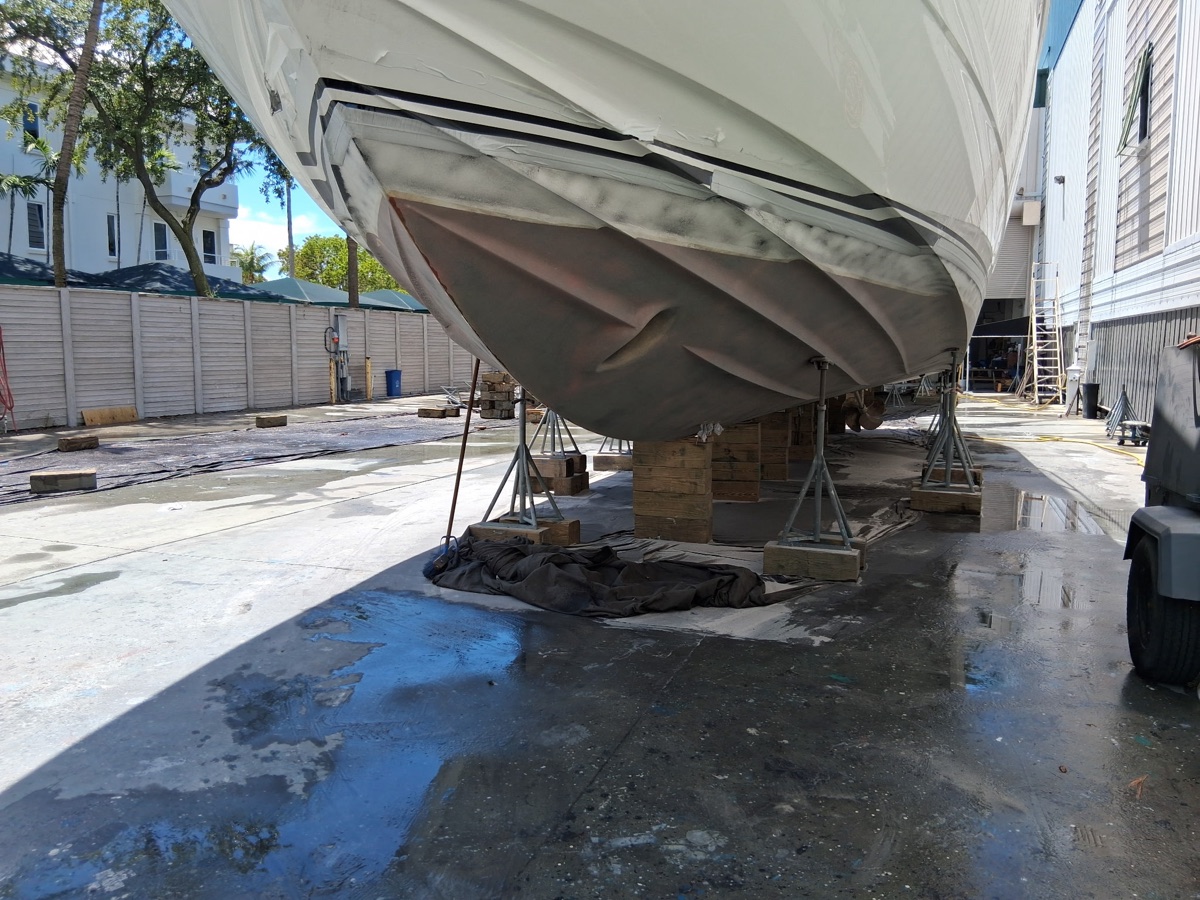
The short version
- Bottom paint is a stack, not a coat, and eventually the stack itself becomes the problem rather than the antifouling on top of it.
- A strip is a deliberate reset of the whole coating system, which is why it gets planned alongside what goes back on.
- Media, pressure, standoff and angle are matched to the hull, so gelcoat sets the limit and the coating has to fit underneath it.
- Old antifouling carries biocides by design, which puts containment, collection and disposal with a licensed and insured crew rather than a rented pot.
- The bare hull is the only honest look you get at blisters, moisture and old repairs, and that look happens before anything new goes on.
- The rig is mobile, so the work happens at the yard or marina where the boat is already blocked.
Bottom paint is a stack, and every stack has a lifespan
Almost nobody sets out to remove bottom paint. What happens instead is a series of perfectly reasonable decisions made one haul out at a time. The boat comes out, the old antifouling gets scuffed, a fresh coat goes on, the boat goes back in. That is the right call in a lot of years. It is also how a hull ends up carrying a coating system nobody alive has seen the bottom of.
Removal is what happens when that accumulation stops being an asset. It helps to picture the bottom not as paint but as a stack: gelcoat at the base, possibly a barrier coat, then layer after layer of antifouling from different seasons and sometimes different chemistries. Every one of those interfaces is a bond, and the assembly is only as strong as the weakest bond in it. Add enough layers and the failure point migrates down inside the stack where you can neither see it nor fix it. The newest coat can be flawless and still come off in sheets, because whatever it was stuck to finally let go.
So the honest definition of bottom paint removal is not a repair, and not a reaction to one bad season. It is a deliberate reset of the entire system back to a known surface. You take everything off, you look at what is really there, and you rebuild from a base you chose instead of one you inherited.
It is also not an annual event. Most owners recoat through several cycles between strips, and knowing where you sit in that rhythm matters more than any calendar. The interval question gets its own treatment in how often to redo bottom paint, so this guide picks up where that one ends: at the strip itself.
Reading the hull: what each symptom says about the stack
Symptoms below the waterline are useful precisely because different failures look different. Rather than running a checklist, it is worth asking what each one is telling you about which part of the stack gave up.
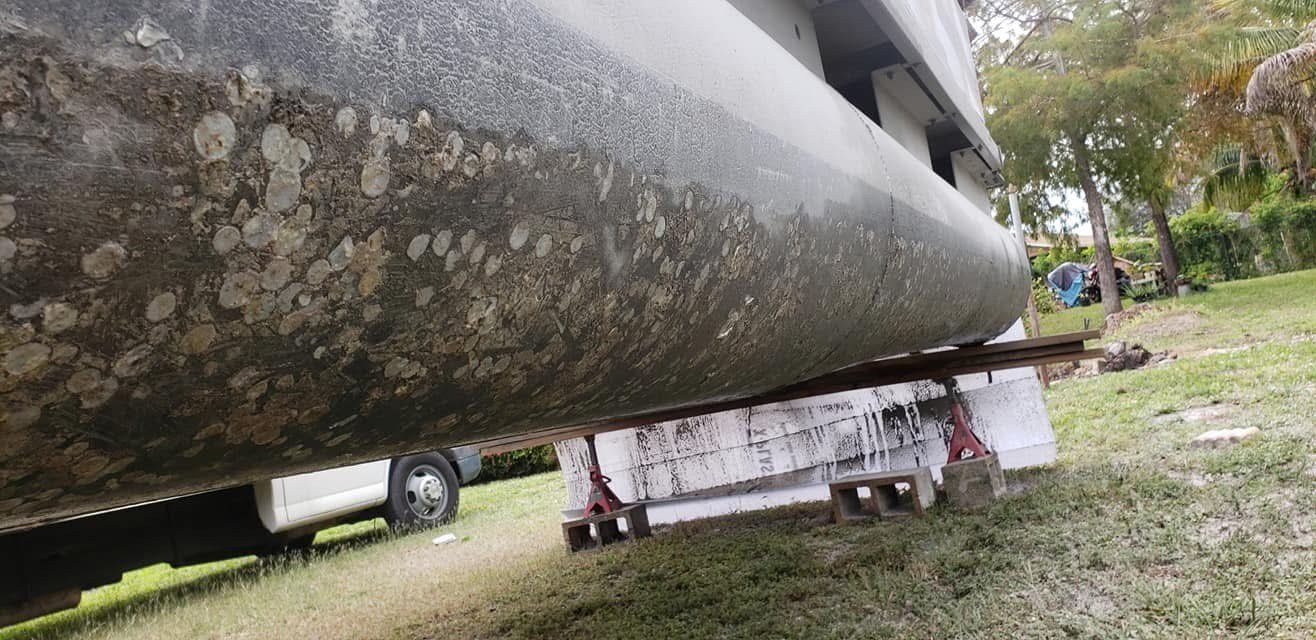
Paint that flakes or peels away in sheets is an adhesion failure, and the sheet itself tells you where it happened. Thick chips showing several colors along the broken edge mean the break occurred deep, not at the surface, and no amount of prep on top will ever reach it. A cracked, dried mud texture across broad areas is a thickness problem: the stack has grown too rigid to flex with the hull and is relieving stress the only way it can. Chalk and faded color on an ablative is a different story and mostly benign, since that coating is engineered to wear away.
Growth that comes back fast after a cleaning says the active layer is spent, which is not the same as the stack having failed. Blisters are the ambiguous one, because a bubble in the paint film and a bubble in the laminate look similar from a few feet away and mean entirely different things. Performance is the quiet symptom, and often the first. A rough, uneven bottom drags, and owners tend to feel it at the helm well before they see it on stands.
Two or three of these showing up together is the usual tipping point. The full look-for-this version, with what to check at haul out, lives in signs your bottom paint needs removal. What matters here is the interpretation: a symptom at the surface is usually reporting on a layer well below it.
Four ways to take a bottom off, and what each one costs you
There are really four approaches to getting old antifouling off a hull, and they trade against the same three things: speed, control, and mess.
Sanding and grinding is the method most owners have tried at least once. It is workable on a small area and becomes miserable across a whole bottom. Soft antifouling loads a disc almost immediately, at which point the paper stops cutting and starts smearing, and a machine held overhead against a curved hull for hours is very hard to keep even. The real risk is not the effort. It is that one moment of inattention takes gelcoat off along with the paint, and gelcoat does not grow back.
Chemical stripping trades dust for sludge. It softens the coating rather than removing it, so there is still scraping, plus a neutralizing step and residue that has to be completely gone before anything will bond over it. On a hull carrying several incompatible layers, one application frequently fails to reach the bottom of the stack, so the process repeats.
Blasting collapses removal and surface preparation into a single pass, which is why it has become the default on hulls. The stream follows curves the way water does, reaching the turn of the bilge and the shadows around running gear where a sanding block physically cannot sit flat. It stops where the operator stops instead of where a spinning disc wanders. Soda blasting and abrasive blasting are both blasting, differing mainly in how hard they hit, which is the next section and also the subject of soda versus sandblasting on a boat hull.
Choosing media for a hull, where the substrate sets the limit
Media selection on a boat is a matching problem with one hard constraint. Gelcoat is thin, it does not regenerate, and once you are into it you are into fairing and repair rather than paint removal. So the substrate sets the ceiling and the coating has to fit underneath it, never the other way around.
Baking soda is the softest option and the one most associated with hull work. It does not cut the surface at all. The crystals fracture on impact and shear off what is sitting on top, which suits fiberglass, gelcoat, aluminum and delicate hardware. It is also water soluble, which changes how rinsing and cleanup get handled at a yard.
Crushed recycled glass is light, sharp and silica free, and it moves heavier or more stubborn coating faster than soda while staying manageable on a hull somebody is reading carefully. Garnet is denser and considerably more aggressive, which puts it on steel hulls, running gear, trailers and serious corrosion rather than on gelcoat. Sand still has a place on heavy forgiving steel where fast, deep removal is the whole point. Dustless, or wet, blasting is a delivery method rather than a separate abrasive: water is introduced with the media, the dust cloud drops, spent material falls instead of drifting across the yard, and heat comes out of the surface.
In practice a single bottom job may use more than one. A soft media on the gelcoat and something with more bite on the steel running gear or the trailer under the same boat is a normal plan, not a complication. Our marine blasting page covers how those calls get made on the water side of the business.
Haul-out day: what the crew actually does
The blasting itself is the short part of the day. Everything around it is the job.
It starts with a walk of the boat while it is blocked. The operator reads the bottom, notes where paint is already lifting, looks for previous repairs, hardware, transducers, anodes and through hulls, marks anything that must not be touched, and settles on media and pressure. A test patch in an inconspicuous spot comes next on nearly every hull, because reading a stack from the outside only gets you so far and the first square foot tells you more than the whole walk did.
Then masking and containment. The boot stripe and waterline get taped to a defined line so the finish above it stays untouched. Shafts, struts, trim tabs, transducers and anodes are covered or handled deliberately. Ground cover goes down beneath the hull so spent media and removed coating land on something that can be picked up rather than in the yard surface. Neighboring boats, vehicles and anything downwind get sheeting when the setup calls for it, and the yard's own containment rules drive a good deal of this.
The blast pass is methodical rather than dramatic: consistent standoff, consistent angle, overlapping passes, working one area to completion before moving on so the operator can watch what is coming off and what is appearing underneath. Then comes the part nobody photographs. The bare hull gets inspected closely, debris and spent media get collected, and the boat is left in a condition the yard is happy with.
Why a properly run blast leaves the gelcoat alone
The question every owner asks, in one form or another, is whether this is going to hurt the boat. It is exactly the right question, and the answer is that damage comes from mismatch, not from blasting.
Four levers control how hard a surface gets hit: the media, the pressure, the standoff distance between nozzle and hull, and the angle of attack. Soften any one of them and the whole impact softens. A gentle media at reduced pressure, held further back and worked at an angle, lifts coating and leaves gelcoat intact. That same nozzle held close, square on, at full pressure with a dense abrasive will go straight through it. The equipment does not decide the outcome. The operator does.
The other half of it is knowing when to stop. Gelcoat is a color layer, not a structural one, and the aim is to finish on it rather than in it. A good operator reads the change as layers come away, watches for the shift in color and texture that says the paint is gone, and eases off just before the surface is fully cleared instead of just after. This is also why running one setting across an entire bottom is a bad sign. Hulls are not uniform, and paint behaves differently on a flat run than it does on the turn of the bilge or in the tight geometry around a strut.
Age is a factor too. An older hull, a thin spot left by a previous repair, or an area that has already been faired will not tolerate what a healthy run of gelcoat shrugs off. That is another reason the walk and the test patch are not ceremony.
What is in old bottom paint, and why containment is not optional
Antifouling works because it is built to be hostile to living things. That is the entire mechanism. Copper compounds and other biocides are in the coating on purpose, they leach slowly into the water while the paint does its job, and what is still in the film on removal day is the portion that never leached. None of that is a scare point. It is simply what the product is.
It does change how removal has to be handled. Everything coming off a bottom is spent antifouling plus whatever abrasive carried it there, and it belongs in a collection plan rather than on the ground or in the water beside the yard. Marinas and boatyards care about this a great deal, which is why most of them have standing requirements about ground cover, containment, and where blasting may happen at all. Those rules exist for good reasons, and a crew that treats them as an obstacle is telling you something worth hearing.
Older boats raise a second question. Coatings from earlier decades, on the bottom and elsewhere on an aging vessel, can carry things nobody would choose to put into the air today, and there is no reliable way to identify that by looking at it. If a boat has real age on it, say so before the work is scheduled so it can be checked rather than assumed.
All of which is the honest reason this is not a weekend project with a rented pot. Respiratory protection, containment, collection, disposal and the judgment about what is actually on the hull are the job, not accessories to it, and a licensed and insured crew carries that so the owner does not have to.
The bare hull: inspection, moisture, and the clock that starts
The moment the last paint comes off is the most informative moment in the life of a bottom, and it is brief. Nobody will get a clearer look at that hull than the one available right then.
What surfaces: osmotic blisters that were hiding under coating, old fairing and repairs and how well they were actually done, gouges, stress marks, thin spots, and corrosion on metal running gear and hardware. On a fiberglass boat the important variable is moisture in the laminate. If water has worked its way in, sealing over it is the one mistake that guarantees the new system fails, so the hull has to dry before anything goes on top of it. How long that takes is set by the boat and the weather, not by a schedule anyone would prefer.
Timing runs in the other direction too. Elsewhere on this site the flash rust problem gets described for bare steel: freshly cleaned metal in salt air and humidity starts oxidizing quickly, so blasting and coating get planned as one continuous operation. A stripped hull has a gentler version of the same clock. The surface is clean and receptive right now, and the longer it sits open in a working yard the more dust, dirt, hands and airborne contamination the next coat will have to bond through.
What comes after, meaning fairing, the barrier coat and how the antifouling goes back on, is a full sequence of its own with its own recoat windows. It is walked through step by step in prepping a hull for new antifouling, and it is worth reading before you book the strip rather than after.
Why Gulf coast boats work through paint faster
Bottom work occupies more of a boat owner's attention here than it does in a lot of places, and the reason comes down to water temperature and a calendar without a real winter.
Fouling organisms are alive, and they behave like anything else alive. Warm, nutrient rich water is a good place to be. The Gulf and the back bays around Naples, Estero Bay, Charlotte Harbor and the barrier islands stay warm enough through most of the year that growth never gets a genuine seasonal break. Antifouling that would be resting for months in a colder climate is working here more or less continuously, which means it gets used up faster.
Faster consumption means more frequent recoating, and more frequent recoating means the stack builds sooner. A boat that has been in the water on this coast for a decade has generally seen more coats than the same boat would have accumulated somewhere colder over the same span. Brackish canal and river spots complicate it further, since some of the worst soft growth appears where fresh water meets salt. Add salt in the air working steadily on trailers, shafts, struts and hardware, and the maintenance rhythm here is simply quicker than the one the paint labels were written around.
None of that is reason to dread it. It is reason to plan for it, and to make the strip a decision you make rather than something that happens to you after a coat fails. The service pages for Naples and Marco Island cover how bottom work gets handled at yards in each area.
Choosing who does it, and what a free on-site look covers
Bottom work is one of those jobs where the quote is the least informative thing in the conversation. Two figures can describe completely different scopes, so the questions matter more than the number.
Worth asking any outfit: what media would you run on my hull and why, how do you decide where to stop, do you strip only or carry it through to coating, how do you contain the work and collect the debris, what is the plan if the laminate turns out to be wet, and are you licensed and insured to work on a vessel at this yard. Answers that get specific about your boat are a far better signal than answers about equipment.
An on-site look is where those answers come from. Somebody reads the actual bottom, the layers, the condition of what is underneath, and the access and blocking at the yard, then turns all of that into a real number instead of a phone guess. The factors that move it are laid out in bottom paint removal cost in Southwest Florida, and the wider framework behind why this site talks about factors rather than figures lives in the cost and buying guide.
SWFL Media Blasters has worked out of Naples since 2015, is licensed and insured, and is fully mobile, so the rig comes to the boat where it is already blocked at the yard or the marina. Blast it, prep it, coat it, or take it back bare and ready for your own painter. Estimates are free. Call or text (239) 227-1768 or use the contact page and we will line up a look at your hull.