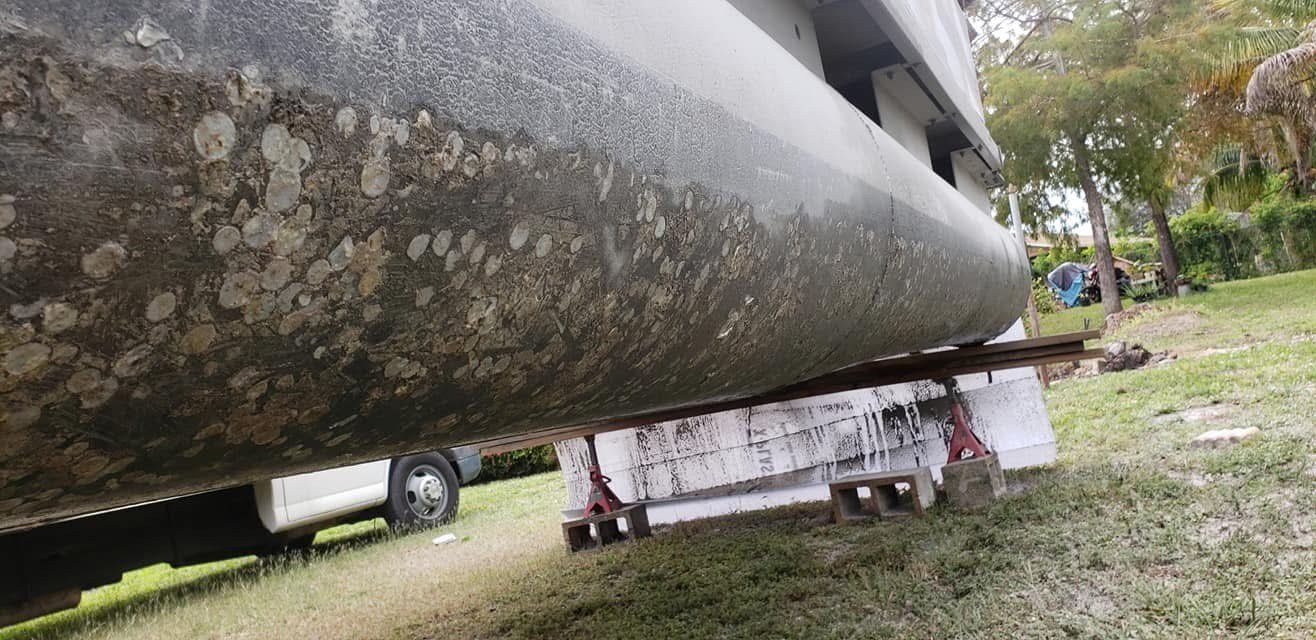
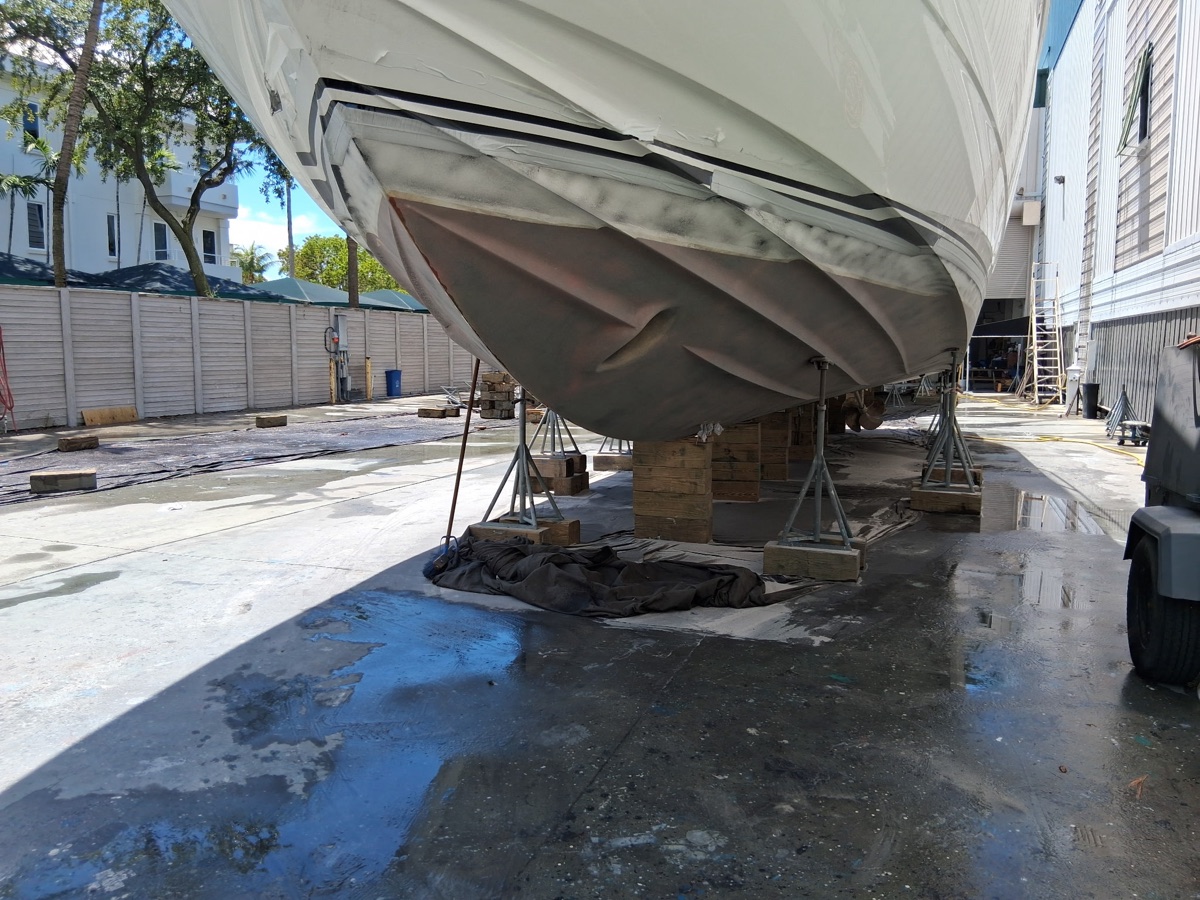
Most Estero boats spend the week out of the water, on a lift behind the house, in a rack at dry storage or on a trailer beside the paver drive. The bottom still ends up carrying more paint than anyone expects.
SWFL Media Blasters takes stacked bottom paint off Estero boats, the ones that work the Estero River and the shallow back bay and then comes back out of the water at the end of the day. Lift kept, rack stored or parked on a trailer beside the drive, an Estero hull collects the same three things: coat over coat of antifouling that nobody ever removed, hard growth from warm brackish water, and a stained ring at the waterline that no amount of scrubbing takes off. We blast the whole film back to clean, sound gelcoat at the address the boat already lives at, and we work behind the gate. Call or text (239) 227-1768 for a free on-site estimate.
Estero boats mostly come out at the end of the run. They go up on a lift behind the house, into a covered rack at a storage facility, or back onto a trailer, and it is reasonable to assume a bottom that spends most of the week in the air has an easy life. The paint does not agree. Ablative antifouling is designed to wear away slowly as the hull moves through water, so a boat that gets lifted and dried between trips never sheds the way the coating expects. It chalks, it hardens in patches, and it holds onto the film that was already underneath it.
Then the season turns and another coat goes on over the top, because rolling on fresh paint is the quick answer and it looks right for a while. Repeat that enough times and the bottom is carrying a thick, brittle stack in which the newest coat is hanging onto older paint whose grip is already gone. It starts checking, chipping and sheeting off in patches, and touching up the bare spots just adds another layer to the pile. That is the point where the film has to come off rather than get topped up again. How often bottom paint gets redone walks the cycle, and bottom paint removal covers what a full strip involves.

Gates are the rule in Estero, so a bottom job here begins with access before it gets to abrasive. Add our name to your visitor list or text a gate code the day before, say which entrance the association wants service trucks using, and tell us whether the truck has a clear run around to the water side of the house. A long paver drive gives us all the staging room anybody could ask for. A tight motor court where the next house's wall sits just off the trailer fender is a different day, and that is better known in advance than discovered on arrival.
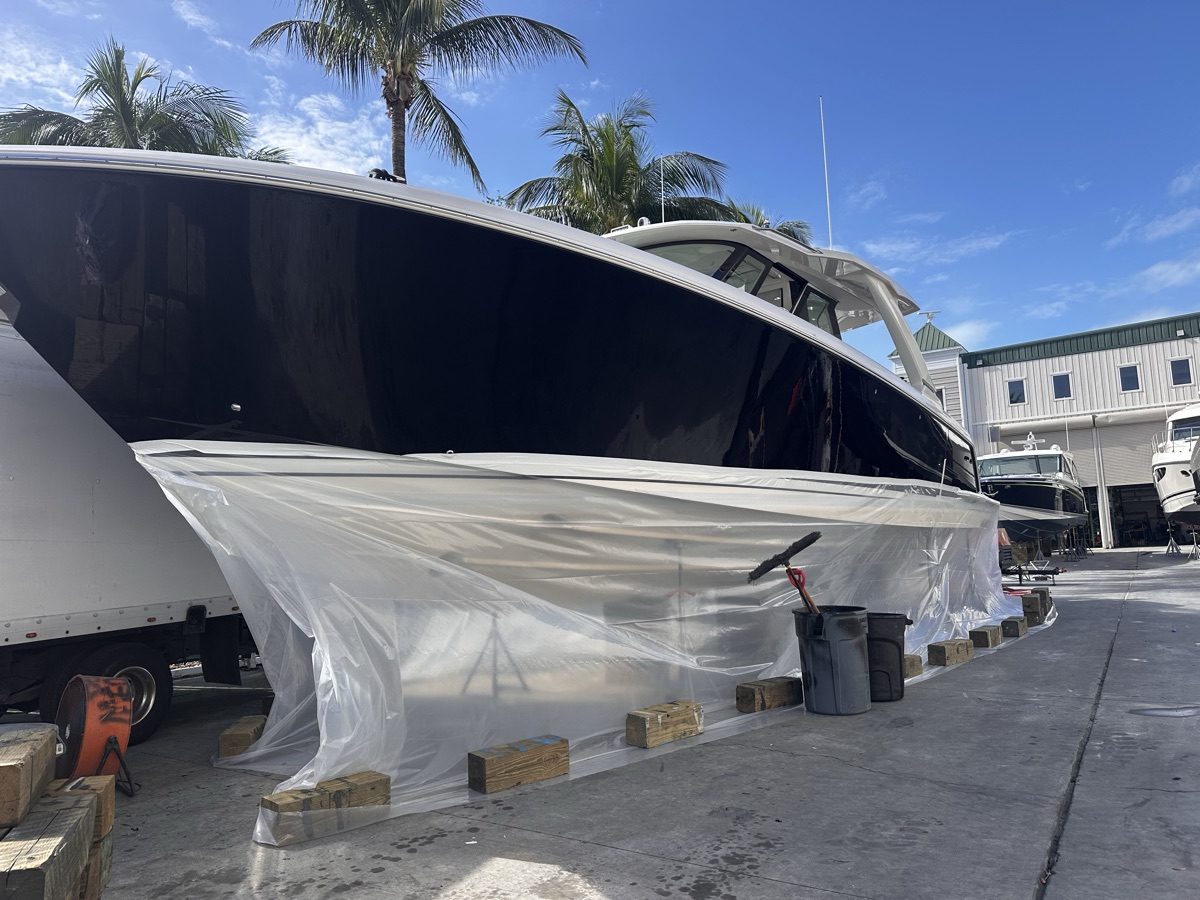
The other thing to settle early is how the boat will be held. A bottom strip needs the entire underside reachable and the hull supported safely, which means blocked on stands, sitting on its trailer, or on a lift with real working clearance beneath it. A boat racked in dry storage has to come down first, and if the facility has its own requirements for tarping, containment and cleanup, we work to them. Where the hull is sitting over open water, containment gets drawn up before anything runs: what is draped, where drop cloths go, where rebound lands, and a wet setup so spent media and chips drop instead of drifting. If the breeze is pushing the wrong way when we arrive, we reposition or come back, a call we would rather make in the driveway than halfway down a hull.
Gelcoat is a thin cosmetic skin over structure, and every decision in a hull strip comes back to that. The media has to hit hard enough to release years of antifouling and still quit the moment it meets sound material. That is a media and pressure choice made in front of your boat, not a matter of moving slower with whatever happens to be in the pot.
Crushed recycled glass handles most fiberglass bottoms. Baking soda is the soft end for a hull or a detail that wants the lightest pass we run, and the wet dustless setup earns its keep near screens, pools and water, since the water carried in the stream knocks dust down and keeps heat out of the laminate. We run a test area first and read what the paint has been covering: old repairs, filler, soft laminate, a field of blisters. If any of that turns up, the plan changes right there and you hear it before the whole bottom is bare.
Hard growth leaves with the paint. Barnacles let go and leave calcium behind, and that scale sits down under the antifouling where a pressure wash never touches it. One controlled pass takes growth, scale and coating together, which is why the surface underneath comes out uniform instead of blotchy. The tradeoff between media is laid out in soda versus sandblasting a boat hull, and soda blasting explains where the gentlest option belongs.

A stripped bottom is a stage, not a finish, and Estero humidity makes the sequence matter. Gelcoat that has just come out from under a stacked film wants to be dry before anything seals it, and if moisture or blistering shows up during the strip, drying and repair come ahead of barrier coat rather than after. Sealing a wet laminate is how a bottom job fails on schedule.
When the hull is sound and dry, the order is barrier coat and then fresh antifouling, onto a surface that still carries the profile the blast left behind. That profile is the reason a blasted bottom holds paint that a sanded slick hull sheds. We can take the job all the way to a coated bottom, or leave the hull bare for your own yard or painter, in which case have that crew booked so a stripped hull is not sitting through a week of afternoon storms. Prepping a hull for new antifouling spells out the condition the hull needs to be in before a drop goes on, and the definitive guide to bottom paint removal runs the job end to end.
A bottom is what it is because of where it swims. The Estero River runs slow and brackish, the back bay behind the islands is shallow and warm, and that combination grows slime, grass and hard growth on anything parked in it. A boat that works the river and then runs out into Estero Bay collects the soft fouling and the hard fouling both, and the antifouling underneath is asked to fight two fights at once. When a particular hull reaches strip time is a function of its hours on the water, its time parked, and the number of coats already riding on it, so the straight answer comes from a look at the boat, not a count of seasons.
Everything else on the boat is related work under a different heading. Trailer frames, axles and brackets, lift beams, cradles and davits, running gear, shafts, struts and hardware corrode in the same air and get handled under marine blasting in Estero, with heavier corrosion covered on the rust removal page. Raise every item at the estimate so it happens in one setup instead of two. Scope on a bottom job tracks hull length, the depth of the paint stack, what shape the gelcoat is in, how tight access and containment are at the house, and whether barrier coat and antifouling go on afterward. The look is free: call or text (239) 227-1768, see the rest of what we cover in Estero, or compare how the same job runs in Bonita Springs.
Based in Naples and mobile across Southwest Florida — we bring the rig to your home, marina, yard or job site. Call or text (239) 227-1768.
Often, yes. What decides it is clearance and containment. We need the full underside reachable and the hull held safely, so a lift that raises the boat well clear works and one that leaves us crawling under a cradle does not. Because the work is happening over water, draping, drop cloths and a wet setup get planned before the first pass. Tell us how the lift sits when you call and you will get a straight answer before the day.
A gate code texted the day before, or our name left with the gate, plus the entrance your association wants trucks at and a heads up if there is a separate service entrance. It also helps to know how tight the drive and motor court are, because that changes how we stage the rig. Should the association ask for a written description of exterior work before it starts, tell us at the estimate and we will write up which surfaces get worked, what media runs and how the area is contained, so you have a sheet to hand over.
Yes. A bottom strip needs the whole underside reachable and the hull supported on stands or a trailer, which a rack slot does not allow. Arrange with the facility to have the boat set down on stands or a trailer for the day, and if it has its own requirements for tarping, containment and cleanup, we follow them. Tell us where the hull will be sitting and we bring the rig to it.
By matching media and pressure to the hull and testing before committing to it. Crushed recycled glass suits most fiberglass bottoms, and soda or the wet dustless setup covers anything that wants the lightest touch. The abrasive is chosen to release the coating rather than cut laminate, and the process runs cool. A small test patch comes first, we read what has been hiding under the paint, and the setup gets adjusted before the rest of the bottom is touched.
Not every year, but eventually. Each coat that goes on without anything coming off adds to a stack, and once that stack is thick and brittle the fresh paint is only holding onto old paint that has already lost its grip. Checking, chipping and sheeting are the signs it has reached that point. Stripping resets the bottom to a known surface so the next system bonds to gelcoat instead of to the failure underneath.
It is closely related work under a different heading. Bottom paint removal is the stacked antifouling below the waterline. Trailer frames, axles and brackets, lift beams, cradles, davits, running gear and hardware fall under marine blasting in Estero. It often makes sense to do both in one setup, with the drapes already hung and the truck already parked, so list everything at the estimate instead of after we begin packing up.
Call or text (239) 227-1768 with the boat, its length, roughly how many seasons of paint are on it, and where it will be sitting, whether that is a lift behind the house, a driveway, a rack facility or a yard. We come look in person and the on-site estimate is free. What moves the scope is the size of the hull, how deep the paint stack runs, what the gelcoat looks like once it is exposed, how the rig can reach and contain the work at your house, and whether you want us to carry it through to coating.
We come through the gate to the lift, the rack or the driveway and take the bottom back to sound gelcoat. Free on-site estimates in Estero: call or text (239) 227-1768.
Tell us a little about the job and we'll get right back to you.
Thanks — we'll be in touch shortly to set up your free estimate.