SWFL Media Blasters
Mobile media blasting & sandblasting — we come to youNaples & all of Southwest Florida
Mon–Sat 8a–6p(239) 227-1768
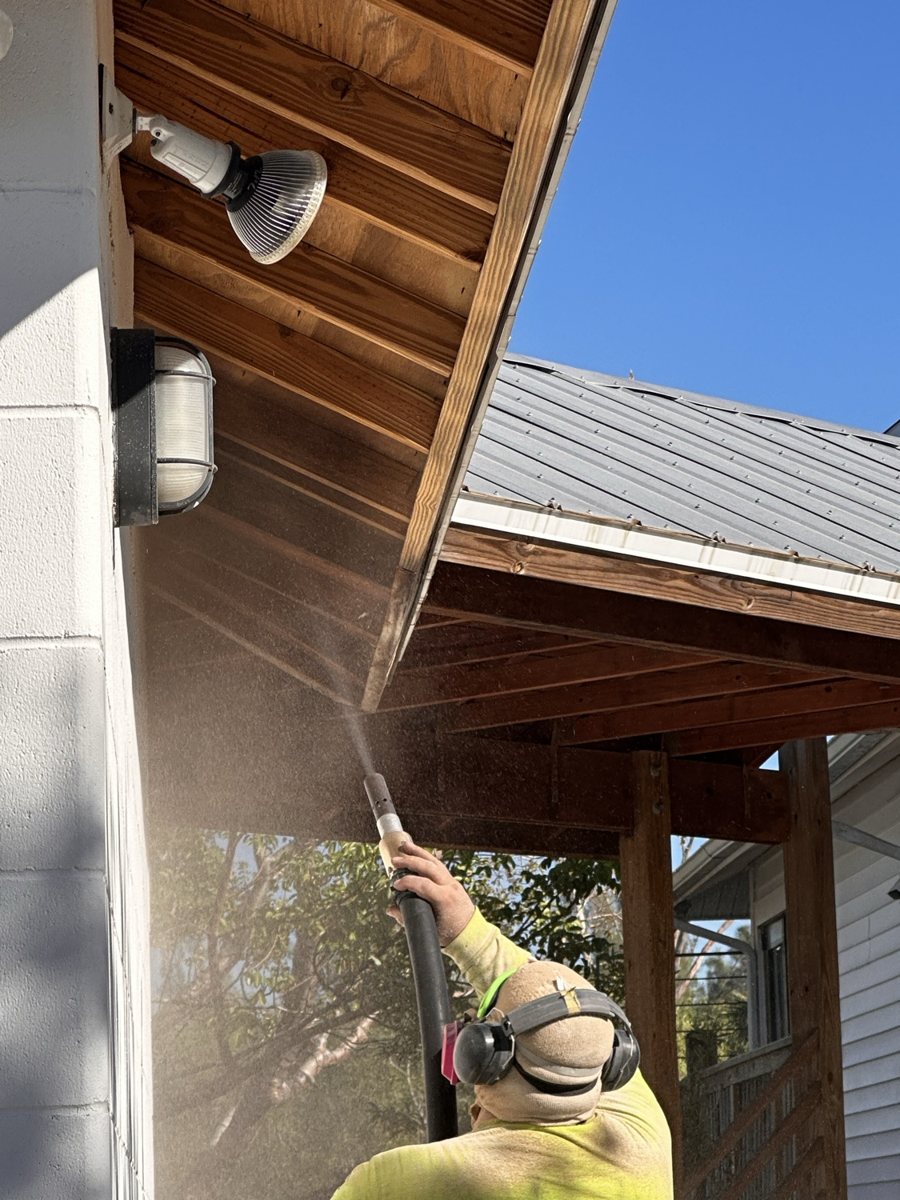
Crew blasting the underside of a wood roof eave, dust visible in the air
Soda Blasting · Estero, FL

Stripping Coatings in Estero Without Cutting the Surface

Sodium bicarbonate is the softest thing on the media rack. Each grain shatters on impact and travels sideways under the finish instead of down into the material, which is why it gets the call on wood, gelcoat, aluminum and anything with detail worth keeping.

(239) 227-1768Text us
Softest media we runLifts finish, spares substrateWater-soluble residueFree on-site estimate

SWFL Media Blasters runs soda blasting in Estero, and this media gets chosen from the bottom up. What sits under the coating decides the abrasive, not the coating itself. Baking soda is soft and friable, so every grain breaks apart the instant it lands and spends that energy sideways, getting beneath the finish and popping it loose instead of driving down into wood, gelcoat or thin aluminum. Estero is built around screened lanais, pool cages, aluminum rails, paver courtyards and boats on the back bay, so the list of surfaces here that need stripping without being cut runs long. Call or text (239) 227-1768 for a free on-site estimate.

The Estero shortlist for a soft abrasive

Start with the surface, not the coating. If the material under the finish is soft, thin, detailed or expensive to replace, soda belongs in the conversation. In Estero that covers a long list, because the neighborhoods here were built with a great deal of aluminum, exposed wood and outdoor living space per house.

Screen cage framing, kick plates and door tracks. Railings, gates and column wraps. Tongue and groove ceilings over a lanai, pergola beams, rafter tails and the wood around an outdoor kitchen. Aluminum window and door frames. Pontoon rails, lift hardware, outboard cowlings and T-top tubing. Castings, hinges, latches, light fixtures, address plaques and anything carrying fine lettering that a wire wheel would erase in one pass.

The common thread is that the coating is the problem and the material is not. Somebody painted over grey weathering, a powder coat chalked and started flaking at the edges, a clear finish clouded, or a piece was sprayed a color the current owner does not want. Soda takes the finish and leaves the piece. If you are unsure whether your surface belongs on that list, that is what a free look decides. Background reading: soda blasting and is media blasting safe for my surface.
  • Cage framing and kick plates
  • Lanai ceilings and beams
  • Railings, gates, column wraps
  • Castings and fine hardware
  • Gelcoat and aluminum trim

What actually happens when the grain hits

Crushed recycled glass and garnet are hard, angular and heavy. They cut, which is exactly what rust and stacked coatings need and exactly what a cypress ceiling does not. Soda behaves differently on contact. The grain fractures, the energy releases along the surface rather than into it, and the finish lifts from underneath while the substrate keeps its shape and its thickness.

Two consequences follow and both matter before anything gets scheduled. First, soda leaves little or no anchor profile, so it strips rather than preps. If the coating going on next needs mechanical grip to hold, a different abrasive has to create that profile in a second step, and we say so at the estimate instead of after. Second, soda runs cool. Thin aluminum panels and light sheet come through flat rather than oil canned, which is a real risk with a hot, heavy abrasive on a thin section.

The residue is water-soluble, so what settles rinses away instead of grinding into paver joints and screen tracks for the next month. It is alkaline, though, which is why the rinse down is part of the job rather than a favor. If you are weighing methods against each other, dustless versus sand versus soda and choosing the right blast media lay out the trade offs.

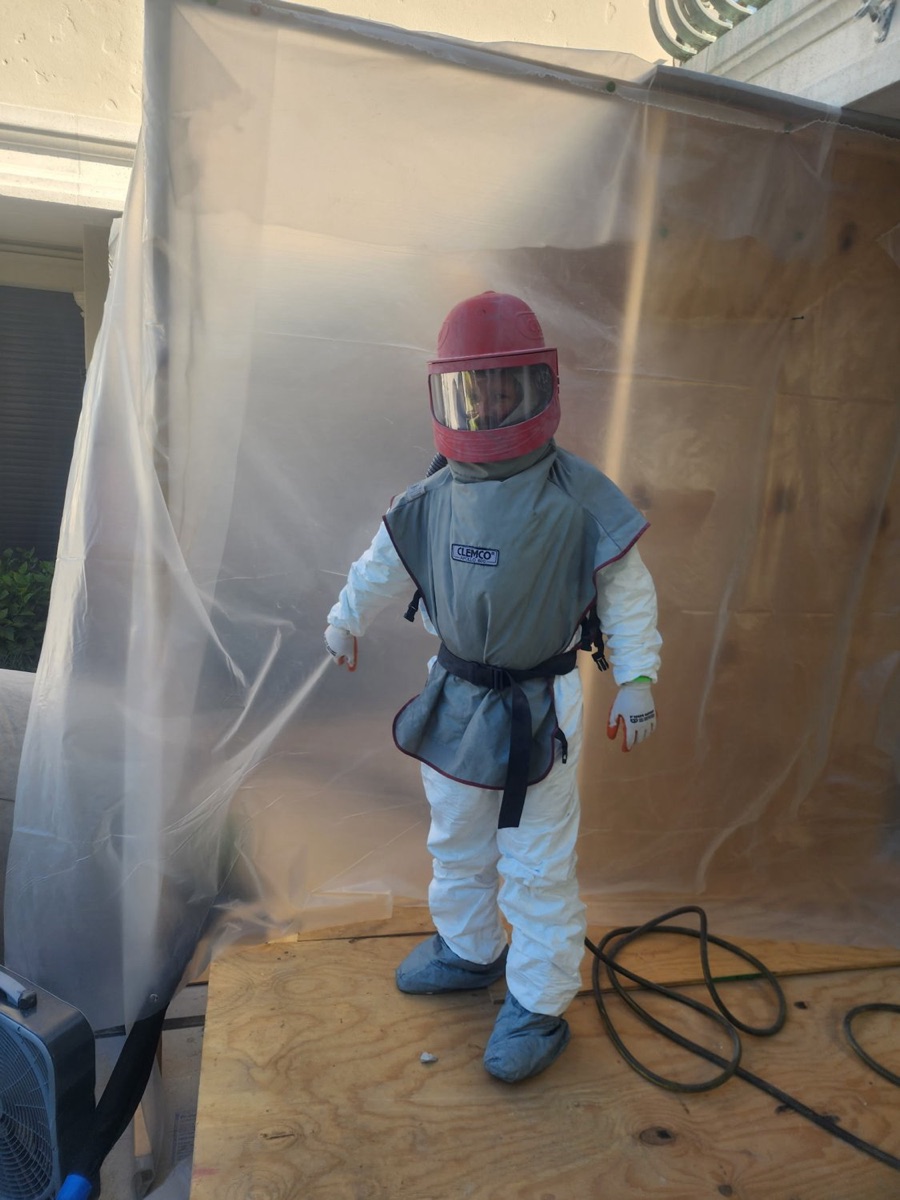
Crew geared up in full containment gear inside a plastic-draped work area

Gelcoat, aluminum and the salt off Estero Bay

Estero sits behind the bay with the Estero River running out to it, and salt film reaches metal and fiberglass whether or not the piece has ever been in the water. Aluminum oxidizes and chalks, fasteners bloom, and gelcoat that has been under sun and salt for years goes dull and starts hiding under whatever was rolled over it last.

Soda suits this material because it takes what is on top without measurably taking what is under it. Gelcoat comes back with its integrity rather than abraded and chalked. Aluminum tube and extrusion do not surrender wall thickness or work harden under a heavy stream. Cast fittings, vintage trim and hardware keep their detail and their maker's marks. On a trailered boat kept at an Estero house, that usually means topsides, rails, cowlings, hatches and hardware get the soft treatment while anything heavier gets planned separately.

Corrosion is where the line falls. Soda lifts coating and surface film off metal, but rust that has pitted into steel needs an abrasive that bites, and no amount of patience with a soft media changes that. How the two metals differ under a nozzle is covered in blasting aluminum versus steel. If the work is on the boat itself, start at marine blasting in Estero.

  • Gelcoat and fiberglass
  • Rails, tubing and cowlings
  • Aluminum window frames
  • Hardware with fine detail
  • Coating off, material intact
Boat equipment covered and protected during on-site work

Where soda hands the job to a cutting media

Soda is a specialist, not a default setting, and the fastest way to waste a day is to send it after work it was never meant for. Heavy rust and mill scale polish under it instead of releasing. Stacked antifouling on a hull bottom is far too much hard material for a media that fractures on contact. Anything headed for a coating system that specifies a measured surface profile needs an abrasive that creates one.

The rest of the rack covers that ground. Crushed recycled glass and garnet cut rust, scale and multi layer coatings, which is the sandblasting in Estero side of the work. Wet and dustless setups knock airborne dust down at the nozzle and keep heat out of thin metal, described on dustless blasting in Estero. Corrosion that has already eaten into steel gates, rails and trailer frames belongs on rust removal in Estero.

Choosing wrong is expensive in a way that stays hidden for a while: a surface that got cut when it never should have been, or a finish that releases in a season because it had nothing to hold. Tell us what is going on the piece afterward and the prep gets matched to it from the start. More on that in surface prep before powder coat or paint.

The rinse down, the gate code and the cage in the way

Access is the first practical question in Estero, not the last. A gated community usually means vendor entry gets arranged ahead of the date, and associations differ on how they handle contractor scheduling and exterior work, so tell us how it runs where you live and the visit gets built to fit rather than improvised at the gate. We are licensed and insured and can send over what your association asks for before the day.

Then there is the pool cage itself, which is the defining feature of a lanai here and the thing that decides where a nozzle can go. Working inside an enclosure means containment inside a space that is already enclosed, and working on the enclosure means protecting everything it surrounds. Pool water, screens, planting beds, outdoor kitchens, furniture and the cars in the driveway get covered before the first pass, and the alkaline residue gets rinsed down when the work is finished. Anything getting coated afterward has to be rinsed thoroughly or the new finish will not bond properly.

What helps on any Estero lot: somewhere to stage the truck within hose reach, a clear path to the piece, and water and power at the address where those are available. The wider picture for the town is on the Estero page, and what moves an estimate up or down is broken out on cost factors.

  • Gate access arranged first
  • Pool and plantings covered
  • Rinse down included
  • Truck staged within hose reach
  • Water and power where available
Where we work

Find us & our service area

Based in Naples and mobile across Southwest Florida — we bring the rig to your home, marina, yard or job site. Call or text (239) 227-1768.

Questions

Good to know

That is the case soda exists for. Wood has soft and hard grain, and an abrasive that cuts eats the soft growth first, leaving a furry, rippled face that takes an enormous amount of sanding to undo. Soda releases finish and grey weathering while the grain keeps its structure. Deep stain does not always let go completely and mildew living inside a board is a treatment question rather than a stripping one, so a test panel goes somewhere nobody looks and you see the result before the rest of the ceiling gets touched.

Not really, and that is the honest answer instead of the convenient one. Soda fractures on impact rather than cutting, so it will lift a coating off metal and clean surface film, but rust that has pitted into steel needs an abrasive that bites, which means crushed recycled glass or garnet. When corrosion is the reason for the call, we run one of those and explain why while we are standing next to the piece. See rust removal in Estero.

Yes, on the parts of a boat where the gelcoat has to survive the process. Topsides, transoms, hardware, rails, cowlings and aluminum fittings all suit a soft media. Stacked bottom paint is a different job, because there is a lot of hard material to remove and the hull is being recoated anyway, so an abrasive that cuts makes more sense down there. Soda versus sandblasting on a boat hull covers the split, and marine blasting in Estero covers how the work gets staged.

Soda is alkaline, so the pool, the plantings and the equipment get treated as things to protect rather than assumed to be fine. Beds, pool surface, outdoor kitchen and furniture get covered before anything starts, the work area is contained, and surfaces get rinsed down when we finish. Tell us what surrounds the work when we come look at it and the containment plan is built around your lanai instead of improvised on the day.

No. Blast it, prep it, coat it is how the business is set up, and the coating half is your call. The piece can go back to you bare and ready for your painter, powder coater or finish carpenter, or we carry it through ourselves. One caveat worth hearing before the work rather than after: soda leaves little or no anchor profile, so a coating that needs mechanical grip requires a second pass with a different abrasive to create one.

Yes, with access arranged ahead of time. Vendor entry, scheduling windows and approval steps vary from one association to the next, so tell us how yours handles contractors and we will schedule inside those rules rather than around them. We are licensed and insured and can provide what the association asks for before the date. Let us know where the truck can stage and how we reach the back of the house.

It comes down to the surface and its condition, how much area there is, how many layers are coming off, how much masking and containment the lanai or the lot demands, and whether a coating follows the strip. Soda is gentler and slower than an abrasive that cuts, so two pieces the same size can land in different places depending on what the material can take. We do not quote work nobody has looked at. See what moves an estimate, then call or text (239) 227-1768 for a free on-site look.

Explore more

Related services

Get started

Wood, gelcoat or aluminum that needs stripping in Estero?

The soft media comes to the house, the finish comes off, and the surface underneath stays the way it was made. Call or text (239) 227-1768 for a free on-site estimate.

(239) 227-1768Text us
Call Text us