Media Blasting in Southwest Florida: The Complete Guide
Everything a boat owner, restorer, homeowner or facility manager needs to know about blasting, prep and coatings on the Gulf coast, from the abrasive itself to how the rig shows up in your driveway.
The short version
- Media blasting strips paint, rust and coatings with compressed air and abrasive, but the real product is the clean, receptive surface it leaves behind.
- SWFL Media Blasters runs crushed recycled glass, garnet, baking soda, sand and dustless (wet) blasting, and matches the abrasive to the substrate first.
- Coating is part of the service, not a handoff: blast it, prep it, coat it, with a bare handback available if that is what you want.
- Salt air and year round humidity shorten the window between bare metal and the first coat, so blasting and coating get planned as one operation.
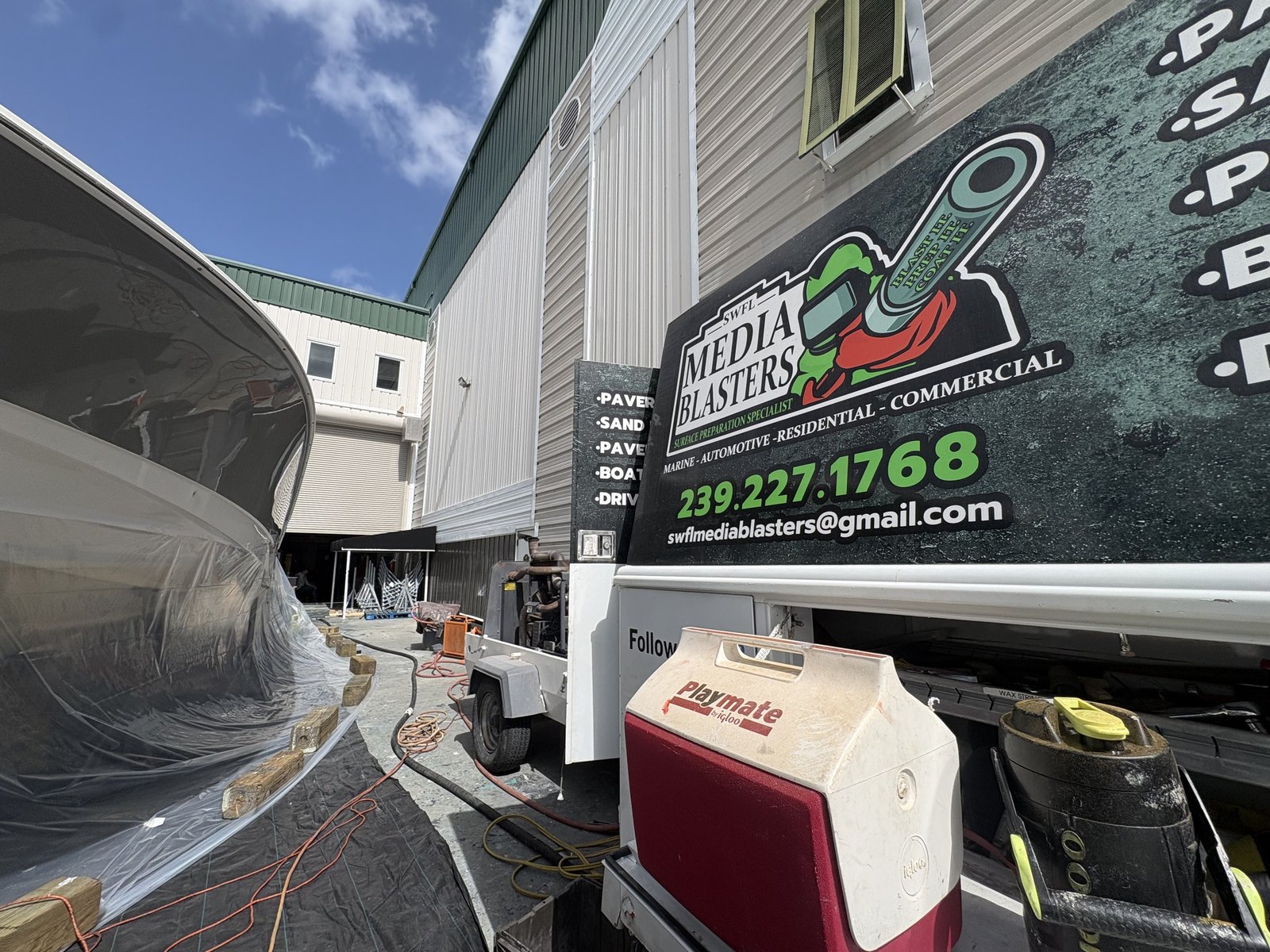
- The rig is mobile, so hulls, frames, driveways, equipment and structural steel get worked where they already sit.
- Older coatings can contain lead and some abrasives contain silica, which is why testing, containment and cleanup belong to a licensed, insured crew.
Media blasting is a surface prep trade, not a paint removal service
Ask ten people what media blasting is and most of them will describe the removal. Paint comes off, rust comes off, old coating comes off. That is the visible part, and it is the part that shows up in videos. It is also the least valuable part of the job. What you are actually buying is the condition of the surface once the dust settles, because that surface is what your next coating has to live on for years.
The mechanics are simple enough to explain in a sentence. A compressor moves a large volume of air, an abrasive is metered into that stream, and the mixture leaves a nozzle aimed at your hull, frame, driveway or beam. Change the abrasive and you change how hard the surface gets hit. Change the pressure and the standoff distance and you change it again. A blaster who understands those levers can take years of layered antifouling off a hull and stop cleanly, or clear mill scale off structural steel and leave behind a texture an industrial coating can bite into.
That is why SWFL Media Blasters frames the work as blast it, prep it, coat it rather than blasting alone. Scott has run the business out of Naples since 2015, and the coating half is optional but rarely wasted. You can have a part handed back bare and ready for your own painter, or you can have the crew carry it through to a finished, protected surface. Both are normal. What is not normal, and what this guide exists to prevent, is treating the strip as the whole job. The full list of services shows where each piece fits.
What happens between the nozzle and bare substrate
Up close, blasting is controlled erosion. Every particle that leaves the nozzle carries energy, and it spends that energy fracturing whatever it lands on. Coating shatters and releases. Rust, which is soft and porous compared with the steel underneath it, blows out of the pits it created. On fiberglass the same stream can be tuned to take antifouling off without going through gelcoat. The stream also follows a curve the way water does, so it reaches the back of a bracket, the inside of a channel and the gap behind a bolt head, all places a sanding pad physically cannot touch.
What is left behind is the real deliverable. On metal it is a fine, even roughness, the tooth a coating grabs. On concrete and pavers it is an open pore structure instead of a glazed film. On wood it is grain with the gray weathered layer lifted away. In every case the surface is not only clean, it is receptive, and those are two different things. A pressure washer can make a driveway clean. It cannot make it receptive.
Compare that with the alternatives. Sanding is fine on a small flat panel and miserable everywhere else. It loads up with soft coating, burns through on edges and rounds off detail you wanted to keep. Chemical stripper works, then leaves you softened sludge, a neutralizing step and residue that has to be completely gone before anything new goes on. Blasting collapses removal and profiling into one pass, which is why it is the default on hulls, frames, equipment and masonry rather than a specialty. For what that texture means once a coating goes over it, see surface prep and profile on structural steel.
The five media we run, and the jobs each one belongs on
Abrasive is not a menu of upgrades where the expensive one wins. It is a matching problem: what the base material can survive, what has to come off, and what is going on afterward. Get that order wrong and you either leave coating behind or damage the thing you were trying to save.
SWFL Media Blasters runs five options, and each has a lane.
- Crushed recycled glass is light, sharp and free of silica. It moves paint and surface rust quickly on steel and is a workhorse on coated metal where you want speed without the weight of a heavy mineral abrasive.
- Garnet is dense and hard. It is the pick when there is real material to move: heavy scale, pitted corrosion, thick industrial coatings, and steel that needs an aggressive tooth before a protective system goes down.
- Baking soda does not cut the substrate at all. It fractures on impact and lifts what is sitting on top, which is why it belongs on aluminum, fiberglass, engine bays, intricate castings and anything with detail you cannot afford to soften. It is water soluble, which changes how cleanup works.
- Sand still earns its place on heavy, forgiving steel where the goal is fast, deep removal and the substrate is in no danger.
- Dustless, or wet, blasting is less a separate abrasive than a different delivery. Water is introduced with the media, which knocks the dust cloud down, weighs spent material so it falls instead of drifting, and pulls heat out of the surface.
The honest version is that most jobs are decided by the softest constraint rather than the toughest. If the substrate is delicate, the abrasive is chosen for the substrate no matter how stubborn the coating is, and the work simply takes longer. Compare the common options in dustless vs sand vs soda blasting, or go straight to soda blasting and dustless blasting.
Marine: hulls, bottom paint, trailers and hardware
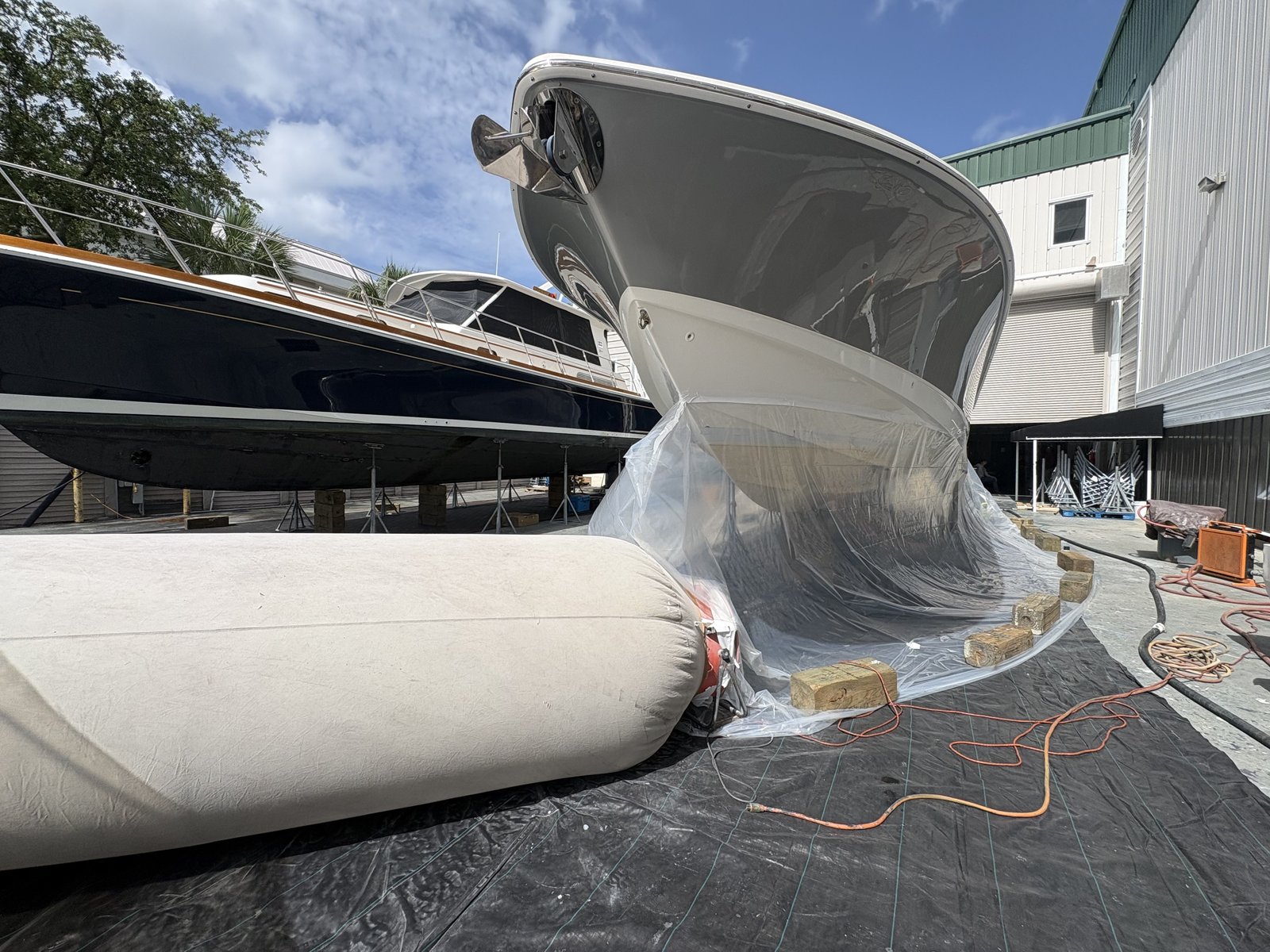
Bottom paint is a stacking problem. Every haul out adds another layer, ablative coatings never fully leave, and after enough seasons the hull carries a thick, uneven, cracking shell that is no longer bonded to what is under it. Blasting is how that stack comes off in one operation instead of days of sanding under a boat on stands. Run at the right pressure with the right abrasive, it stops where it is supposed to, and what you get back is a fair, clean bottom that new antifouling can key into.
Blisters change the plan. If moisture has worked into the laminate, stripping the paint is the step that exposes it, and the hull needs to dry before anything is sealed over the top. That is a conversation to have before the boat comes out of the water, not after. The same goes for running gear, trim tabs, struts and through hull hardware, where old paint and corrosion hide in exactly the spots a sanding block never reaches.
Trailers are the other half of marine work and the half people forget. A trailer that gets dunked in salt water and driven home wet is on a faster corrosion clock than the boat riding on it. Frame rails, cross members, fender brackets and the inside of tubing rot from the seams outward. Taking a trailer to bare steel and coating it immediately is one of the more worthwhile jobs on a boat owner's list. Start with marine blasting and bottom paint removal, or read the practical version in prepping a hull for new antifouling. Boats kept around Marco Island and the barrier islands sit in salt water year round, which is a different maintenance rhythm than a seasonal boat up north.
Automotive and restoration: frames, undercarriages and bare metal
A restoration lives or dies on what is under the paint, and nobody knows what is under the paint until it comes off. Blasting a frame or a body shell is part removal and part inspection. Patched rot, prior filler, hidden pitting and old repairs all surface at once. It is far better to find them with the part bare on stands than after primer is on and the panel looks finished.
Undercarriages in coastal Florida are their own problem. Salt in the air is only part of it. Road spray, boat ramps, standing water in low spots after a summer storm and constant humidity mean the underside of a truck stays damp long after the top has dried. Surface rust becomes scale, scale traps moisture, and the cycle feeds itself from there. Taking it back to clean steel and getting a coat on before rust has a chance to creep back breaks the loop.
Abrasive choice matters more here than almost anywhere else. Thin sheet metal, floor pans, quarter panels and aluminum components will distort if they are hit too hard, because heat and impact both work against a panel with nothing behind it. That is where soda and lighter glass earn their keep. Heavy frame steel is the opposite case and takes an aggressive abrasive without complaint. If the part is headed out for powder coat, the coater will care about the tooth and about how fast the part reaches them, because bare steel does not wait politely in this climate. See automotive blasting and rust removal, and for the step by step version, blasting a car frame and what to expect.
Residential and concrete: pavers, driveways, pool decks and lanais
Concrete and pavers fail in a way that confuses people. The stone is usually fine. What went wrong is the film on top of it: an acrylic sealer that has clouded, yellowed, flaked or gone milky white after water got trapped underneath, or a coating on a pool deck peeling off in sheets. Pressure washing that surface makes it wet and slightly cleaner and does nothing at all to the film. Chemical strippers can soften sealer, but across a large paver field you then spend the day chasing residue out of every joint.
Blasting takes the film off mechanically and leaves the stone open again. On pavers the joints get cleared at the same time, which is exactly what has to happen before anything is resanded and resealed. On a stamped or broom finish driveway the abrasive and the pressure get dialed back so the existing texture survives rather than getting cut away. Travertine and brick each behave differently and get treated differently.
Paint on block walls, garage floors, seawall caps, lanai posts and enclosure framing all sit in the same family. So does soda blasting on wood, which lifts the gray weathered layer and old finish off a ceiling, a pergola or exposed beams without fuzzing the grain the way sanding does. For homeowners the real questions are usually about mess and about what the yard looks like when the truck leaves, which is where wet blasting and proper containment do the work. There is more detail in removing old paver sealer and restoring a pool deck or lanai, and the service pages are residential blasting and paver sealer removal.
Commercial and industrial: equipment, structural steel and fleets
Commercial work gets measured in downtime more than in square footage. An excavator or a loader that has to be trucked to a shop is a machine that is not earning, and the hauling eats time on both ends. Bringing the rig to the yard, the lot or the site changes that math, because the machine is stripped and coated where it sits and goes back to work from the same spot.
Structural steel has its own logic. Beams, columns, stair towers, railings, canopies and mezzanines carry mill scale and failing coating that a new protective system will not bond through. The specification typically calls for a defined cleanliness and a defined tooth, and blasting is the only practical way to hit both on steel that is already erected. Access, containment and the order of operations matter as much as the blasting itself once other trades are working the same site.
Fleets are a volume problem instead. Box trucks, trailers, service bodies, tanks and chassis all age on the same curve and all need the same thing, which makes scheduling the useful conversation: which units come out of rotation, in what order, and how quickly they turn around. Marine, rental and service fleets on the Gulf coast take the extra hit from salt, and equipment stored outdoors year round takes it constantly. Start at commercial blasting, and for the operational angle read on-site blasting and equipment downtime or fleet and trailer restoration.
Why salt air and humidity change the schedule here
Everything above happens differently on the Gulf coast, and the difference is mostly about time. Bare steel is at its most vulnerable the moment it is clean. Strip it in a dry climate and you have a comfortable window before oxidation starts. Strip it here, with salt in the air and humidity sitting high most of the year, and that window closes fast. Flash rust, the light orange bloom that shows up on fresh steel, is not cosmetic. Coat over it and you have built a failure point into the system on day one.
That single fact reorganizes how a job is planned. Blasting and coating are scheduled as one operation rather than two, weather gets watched because surface temperature and dew point decide whether a coating can go down at all, and the sequence is settled before the compressor ever starts. A crew that only strips hands the problem to whoever coats next. A crew that does both owns it.
Salt does more than speed up rust. It holds moisture against the surface, and it hides in pits, seams, lap joints and the inside of tubing where a rinse never reaches. Getting that contamination off the substrate is part of prep, not an optional extra, which is one reason blasting outperforms a wash and a scuff on anything that has lived near the water. The same climate is why coatings on a Naples driveway, a hull and a trailer frame all age faster here than the same coatings do inland. Property in Bonita Springs, with the Gulf on one side and Estero Bay behind Little Hickory Island on the other, takes salt from both directions.
How a mobile rig actually gets to your surface
Mobile is the entire model, not a convenience feature. The compressor, the pot, the media, the hose and the containment come to the boat, the driveway, the yard or the jobsite. That removes the hardest part of most projects, which is moving something large and awkward that may not even be roadworthy in its current state, and it means you are standing right there while the work happens instead of waiting for a call from a shop.
What a rig needs is simple and worth knowing before the crew arrives. Room to park within hose reach of the work, a clear path to the surface, and a short conversation about water and power. Gated communities and HOA lots usually mean access has to be arranged in advance, with a gate code or a name on a list, plus some awareness of what the neighbors are looking at. Boatyards and marinas have their own rules on containment, working hours and where a vessel can be worked, and those rules come first. Tight island driveways and short setbacks change where the truck sits and how much hose goes out. A canal side backyard can be the easiest access on the property or the hardest, depending on the gate.
Containment is the other half of showing up well. Sheeting, drop cloths, masking over glass and hardware, and wet blasting anywhere dust would otherwise travel are what separate a job the neighbors never noticed from one they call about. Spent media and removed coating get collected rather than left in the grass. If you are weighing whether the project should go to a shop instead, mobile vs shop blasting lays out both sides, and the service area page shows the towns the rig covers.
Choosing a blaster, and the dust question nobody asks first
Most people call about a surface. The question worth asking alongside it is what happens to everything that comes off that surface. Blasting puts a lot of material into the air in a hurry, and what is in that cloud depends on what was sitting on the substrate and what abrasive is being thrown at it. Some mineral abrasives contain crystalline silica, which is much of why silica free options such as crushed recycled glass exist and why wet methods matter beyond tidiness.
Older coatings are the other consideration. Paint on an older building, an old boat, a vintage frame or legacy equipment can contain lead, and there is no reliable way to tell by looking. That is why testing before the work starts, real containment while it runs, and collecting the spent media and debris afterward instead of hosing it into the yard are the marks of a crew doing this properly. It is also the honest reason blasting is not a rent a machine and figure it out project. The respiratory protection, the containment, the disposal, the insurance and the judgment about what is on the surface are the job, and a licensed and insured contractor carries that so you do not.
When you compare options, ask what abrasive they would use and why, whether they coat or only strip, how they contain and clean up, and whether they are insured for work on your property or your vessel. SWFL Media Blasters has worked out of Naples since 2015 and holds a 4.8 star rating across 25 Google reviews. Quotes come from an on-site look rather than a phone guess, because the size of the area, the substrate, the layers of coating, the access and whether coating follows all change the answer. Estimates are free. Call or text (239) 227-1768 or use the contact page, and if you mainly want to know whether your surface can take it, is media blasting safe for my surface answers that one directly.